
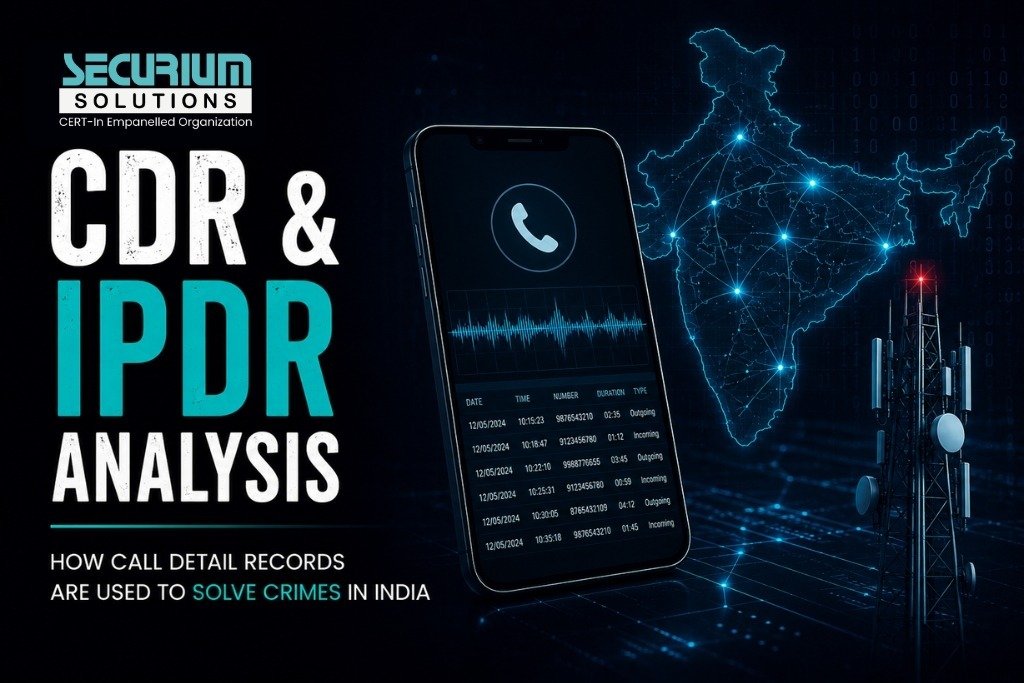
In India’s criminal justice system, Call Detail Records (CDR) and Internet Protocol Detail Records (IPDR) have become some of the most powerful tools available to investigators. These records — obtained from mobile network operators and internet service providers — can map where a suspect was at a specific time, who they communicated with, how long they spoke, and what internet sessions they initiated. In the hands of a trained forensic analyst, CDR and IPDR data can reconstruct entire criminal timelines.
What is a CDR (Call Detail Record)?
A Call Detail Record is a data record generated by a telecommunications company for every call made or received through their network. It contains:
- The calling and called phone numbers (A-party and B-party)
- The date, time, and duration of every call
- The cell tower or base station that handled the call — revealing the approximate location of the device at the time of the call
- The International Mobile Equipment Identity (IMEI) number of the device used
- Whether the call was made, received, or missed
CDR data is available to law enforcement agencies through legal process (court orders or letters rogatory) and to private parties through appropriate legal channels. Our forensic team can assist with the analysis of CDR data once it has been lawfully obtained.
What is an IPDR (Internet Protocol Detail Record)?
An IPDR is the internet equivalent of a CDR. It is generated by an ISP or mobile network operator for every internet session initiated through their network and contains:
- The date, time, and duration of every internet session
- The IP address assigned to the subscriber during each session
- The volume of data transferred during each session
- The subscriber identity linked to the session — which can be used to identify the user
IPDR data is particularly valuable in cybercrime investigations — it allows investigators to trace who was assigned a specific IP address at a specific time, connecting online activity (fraud, threats, hacking) to a real-world subscriber identity.
What Can CDR & IPDR Analysis Tell Us?
In the hands of a trained forensic analyst, CDR and IPDR data can answer critical investigative questions:
- By mapping the cell towers used during each call, we can establish the approximate location of a device at any given time — placing a suspect at or away from a crime scene.
- Analysis of calling patterns reveals who a person regularly communicates with, when, and for how long — identifying associates, accomplices, and potential witnesses.
- If a person claims to have been somewhere at a specific time, CDR tower data can corroborate or contradict that claim with objective evidence.
- IPDR data combined with ISP records can trace an online perpetrator — a fraudster, a hacker, a blackmailer — from their IP address back to a real-world identity.
- Call records can reconstruct the precise sequence of communications before, during, and after an incident — establishing a timeline that can support or undermine a case narrative.
How We Analyse CDR & IPDR Data
Raw CDR and IPDR data from network operators is delivered in large spreadsheet files containing hundreds of thousands of records. Interpreting this data correctly requires specialist software, forensic training, and knowledge of Indian telecommunications infrastructure.
Our forensic analysts use dedicated CDR analysis tools to process, visualise, and interpret call record data — producing clear, easy-to-understand reports with timeline charts, communication maps, and location heatmaps that can be presented effectively to a court or investigating officer.
Legal Framework for CDR Evidence in India
CDR and IPDR data is admissible as electronic evidence in Indian courts under Section 65B of the Indian Evidence Act, provided it is accompanied by a proper certificate from the authorised custodian of the records and analysed by a qualified examiner. Our forensic reports meet all requirements for CDR evidence admissibility, and our analysts are available to provide expert witness testimony.
Frequently Asked Questions
Can a private individual or law firm request CDR analysis services?
Yes. We provide CDR and IPDR analysis services to law enforcement agencies, legal professionals, corporations, and private individuals. Note that the CDR/IPDR data itself must be obtained through appropriate legal channels (court order or operator disclosure). We can assist with the analysis once the data has been lawfully obtained, and we can advise on the process for obtaining the records.
How accurate is cell tower location data from CDR records?
Cell tower location data is approximate — it tells us which tower served a call, and each tower covers a geographic area that can range from a few hundred metres in an urban area to several kilometres in a rural area. It is not GPS-level precision, but it is extremely valuable for establishing whether a device was in a general area at a specific time, and it is regularly accepted as evidence in Indian courts.
How long does CDR analysis take?
Standard CDR analysis for a single subscriber over a 3-month period typically takes 3–5 working days, producing a full report with timeline, communication maps, and location analysis. Larger datasets or multi-subscriber analysis requires additional time. Priority turnaround is available for urgent cases.
📞 CALL TO ACTION
Need CDR or IPDR analysis for your case? Our forensic analysts provide detailed, court-admissible CDR analysis reports across India. Call us today for a confidential consultation.
📞 +91 8368545467 | 📧 sunil.singh@securiumsolutions.org