APIs have become the backbone of modern digital businesses. Mobile applications, SaaS platforms, fintech systems, payment gateways, healthcare portals, ecommerce websites, cloud platforms, and enterprise software all depend on APIs to exchange data and connect services.
But APIs also create serious security risks. If an API is poorly secured, attackers may access sensitive data, bypass authentication, manipulate transactions, abuse business logic, or take control of backend systems.
This is why API penetration testing services in India are becoming essential for businesses that want to protect customer data, secure digital transactions, and reduce cyber risk.
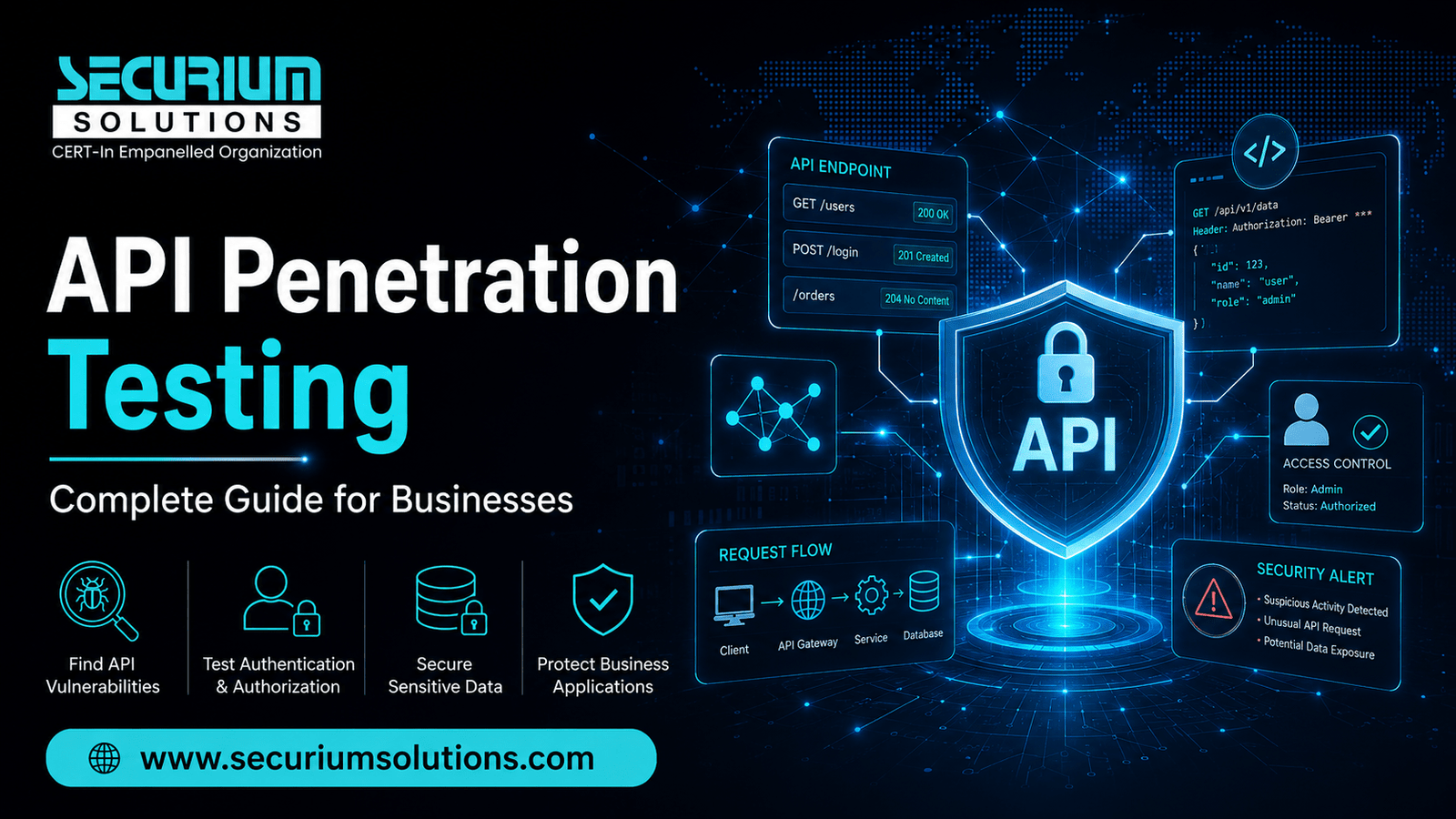
API penetration testing helps businesses identify, validate, and fix API vulnerabilities before attackers can exploit them.
What Is API Penetration Testing?
API penetration testing is a cybersecurity assessment where security experts test APIs to identify vulnerabilities that attackers could exploit.
The goal is to check whether the API is secure against real-world attack techniques.
During API security testing, cybersecurity professionals assess areas such as:
-
- Authentication
- Authorization
- API endpoints
- Access control
- Rate limiting
- Input validation
- Token security
- Session handling
- Data exposure
- Business logic
- API request and response flow
- Error handling
- API documentation exposure
- Third-party API integrations
API penetration testing is important because APIs often handle sensitive business logic and user data behind the scenes. Even if the frontend application looks secure, a weak API can expose the entire system.
Why Is API Penetration Testing Important?
APIs are often directly connected to databases, user accounts, payment systems, internal services, and confidential business data. If attackers exploit an insecure API, the impact can be serious.
Here are the major reasons why businesses need API penetration testing.
1. Protects Sensitive Data
APIs transfer sensitive data between applications, users, and backend systems. API testing helps identify weaknesses that may expose customer data, financial records, personal information, or business documents.
2. Prevents Unauthorized Access
Weak authentication and authorization can allow attackers to access data or functions they should not be able to use. API penetration testing helps detect these access control issues.
3. Secures Mobile and Web Applications
Most mobile apps and web applications rely on APIs. If the API is insecure, attackers can bypass the app interface and directly attack the backend.
4. Reduces Fraud and Business Logic Abuse
In fintech, ecommerce, wallet, booking, and payment systems, attackers may try to manipulate API requests to change prices, bypass payment steps, abuse coupons, or perform unauthorized transactions.
5. Supports Compliance and Client Requirements
Many industries require API security testing for audits, enterprise onboarding, vendor security reviews, and regulatory expectations. Regular testing improves compliance readiness and client confidence.
Common API Vulnerabilities Found During Penetration Testing
A professional API penetration test can uncover many types of security weaknesses. Some issues may be technical, while others may be related to business logic.
Common API vulnerabilities include:
-
- Broken Object Level Authorization
- Broken Authentication
- Broken Function Level Authorization
- Excessive Data Exposure
- Mass Assignment
- Lack of Rate Limiting
- Security Misconfiguration
- Injection Attacks
- Weak Token Management
- Insecure API Keys
- Improper Error Handling
- Sensitive Data Exposure
- Missing Input Validation
- Insecure Direct Object References
- Business Logic Flaws
- Insecure Third-Party API Integrations
- Weak Encryption
- Missing Logging and Monitoring
- Unrestricted Access to Sensitive Endpoints
- Poor API Version Management
Not every API vulnerability has the same impact. Some may expose limited information, while others can lead to account takeover, data theft, financial fraud, or backend compromise.
OWASP API Top 10 and API Security
The OWASP API Top 10 is a widely used reference for understanding common API security risks. It helps businesses and security teams identify major categories of API vulnerabilities.
Some major API security risks include:
Broken Object Level Authorization
This happens when an API allows users to access objects or records that do not belong to them. For example, a user may change an ID in the API request and access another customer’s data.
Broken Authentication
Weak login systems, poor token validation, missing MFA, insecure password reset flows, or predictable tokens can allow attackers to gain unauthorized access.
Broken Function Level Authorization
This happens when users can perform functions they should not be allowed to access. For example, a normal user may access admin-level API actions.
Excessive Data Exposure
APIs sometimes return more data than required. Even if the frontend hides it, attackers can inspect API responses and extract sensitive information.
Lack of Rate Limiting
If an API does not control the number of requests, attackers may perform brute-force attacks, credential stuffing, scraping, or denial-of-service attempts.
Security Misconfiguration
Misconfigured API gateways, exposed debug information, weak CORS settings, missing headers, or unnecessary endpoints can create security risks.
Understanding these risks helps businesses take API security more seriously.
API Penetration Testing Process
A professional API penetration testing engagement follows a structured process. This ensures safe testing and clear results for the business.
Step 1: Scope Definition
The first step is to define the API testing scope. This includes API endpoints, environments, documentation, user roles, authentication methods, test accounts, and business workflows.
A clear scope helps security experts understand what needs to be tested.
Step 2: API Documentation Review
Security testers review API documentation, endpoint details, request methods, parameters, authentication flows, and expected responses.
This helps understand how the API is designed and where risks may exist.
Step 3: Authentication Testing
Testers check whether authentication mechanisms are secure. This includes testing login flows, tokens, password reset functions, session expiration, MFA implementation, and credential handling.
Step 4: Authorization Testing
Authorization testing checks whether users can access only the data and functions they are allowed to use. This is one of the most important parts of API penetration testing.
Step 5: Input Validation Testing
Testers check whether the API properly validates user input. Poor input validation can lead to injection attacks, parameter tampering, and unexpected behavior.
Step 6: Business Logic Testing
Business logic testing checks whether attackers can abuse the intended workflow. For example, they may try to manipulate payment amounts, bypass approval steps, reuse coupons, or access restricted operations.
Step 7: Rate Limiting and Abuse Testing
Security experts check whether the API has proper controls to prevent brute-force attacks, scraping, spam, credential stuffing, and automated abuse.
Step 8: Sensitive Data Exposure Testing
Testers analyze API responses to check whether unnecessary or sensitive data is being exposed.
Step 9: Risk Rating
Each vulnerability is classified based on severity, such as Critical, High, Medium, Low, or Informational. This helps businesses prioritize remediation.
Step 10: Reporting
The final report includes vulnerability details, affected endpoints, request and response evidence, proof of concept, business impact, technical impact, and remediation steps.
Step 11: Retesting
After the development team fixes the issues, retesting is performed to confirm that vulnerabilities have been properly resolved.
API Penetration Testing vs Web Application Testing
API penetration testing and web application testing are closely related, but they are not the same.
Web application testing focuses on the frontend, web pages, forms, sessions, and browser-based workflows.
API penetration testing focuses on backend communication, endpoints, tokens, request manipulation, authorization, data exposure, and business logic at the API level.
A website or mobile app may look secure from the user interface, but the API behind it may still be vulnerable. That is why businesses should test both the frontend application and the APIs powering it.
What Should an API Penetration Testing Report Include?
A professional API pentest report should be clear and useful for developers, security teams, and business leaders.
A good API penetration testing report should include:
-
- Executive summary
- Scope of testing
- API endpoints tested
- Testing methodology
- Vulnerability details
- Severity rating
- Affected endpoints
- Request and response examples
- Proof of concept
- Business impact
- Technical impact
- Screenshots or evidence
- Remediation steps
- Retesting status
- Final recommendations
The report should help developers understand exactly what needs to be fixed and why it matters to the business.
When Should Businesses Conduct API Penetration Testing?
API penetration testing should be conducted regularly because APIs change frequently. New endpoints, integrations, features, and authentication updates can introduce new security risks.
Businesses should conduct API testing:
-
- Before launching a new API
- Before releasing a new mobile or web app
- After adding new API endpoints
- After changing authentication systems
- After integrating payment gateways
- After connecting third-party APIs
- Before compliance audits
- Before enterprise client onboarding
- After a security incident
- At least once or twice a year
Regular API testing helps businesses reduce risk and maintain stronger security.
Which Businesses Need API Penetration Testing?
Any business that uses APIs should consider API security testing. It is especially important for businesses that handle sensitive data, financial transactions, or user accounts.
These include:
-
- Fintech companies
- Banking and finance businesses
- SaaS platforms
- Ecommerce websites
- Mobile app companies
- Healthcare platforms
- EdTech platforms
- Insurance companies
- Payment gateways
- Travel and booking platforms
- Government portals
- Logistics platforms
- Enterprise software companies
- Cloud-based businesses
If your business uses APIs for login, payments, user data, dashboards, transactions, integrations, or mobile app communication, API penetration testing is highly recommended.
Business Benefits of API Penetration Testing
API penetration testing provides both technical and business benefits.
Stronger Data Protection
It helps prevent unauthorized access to sensitive customer and business data.
Reduced Risk of Account Takeover
Testing helps identify weak authentication, poor token handling, and authorization flaws that may lead to account compromise.
Better Fraud Prevention
API testing helps detect transaction manipulation, payment abuse, coupon abuse, and workflow bypass risks.
Improved Compliance Readiness
API security testing supports compliance and audit requirements for industries such as fintech, banking, healthcare, SaaS, ecommerce, and government.
Increased Customer and Client Trust
A secure API environment builds confidence with customers, partners, investors, and enterprise clients.
Better Development Quality
API pentest reports help developers understand security gaps and improve secure coding practices.
Why Choose Securium Solutions for API Penetration Testing?
Choosing the right cybersecurity partner is important because API penetration testing requires deep knowledge of authentication, authorization, backend logic, API architecture, business workflows, and real-world attack techniques.
Securium Solutions is a CERT-In Empanelled cybersecurity company offering professional API penetration testing, VAPT, web application testing, mobile application penetration testing, network penetration testing, cloud security assessment, compliance audits, digital forensics, incident response, SOC/SIEM monitoring, and managed security services.
Our expert-led testing approach helps businesses identify API vulnerabilities, understand real cyber risk, and fix security gaps with practical remediation guidance.
Whether you are running a fintech platform, SaaS product, ecommerce application, healthcare portal, mobile app backend, or enterprise API system, Securium Solutions can help secure your APIs before attackers exploit them.
APIs are powerful, but they can also become one of the biggest security risks if not tested properly. Since APIs often connect directly with backend systems and sensitive data, even a small vulnerability can lead to serious business impact.
API penetration testing helps businesses identify hidden weaknesses, validate real-world risks, and fix vulnerabilities before attackers take advantage of them.
For modern businesses, API security is not optional. It is essential for data protection, compliance, customer trust, and secure digital growth.
Need API Penetration Testing Services in India?
Securium Solutions helps businesses secure their APIs through expert-led API penetration testing, VAPT, web application testing, mobile app testing, compliance audits, cloud security assessments, digital forensics, SOC monitoring, and managed cybersecurity services.
Contact Securium Solutions today to identify and fix API vulnerabilities before attackers exploit them.
FAQs
What is API penetration testing?
API penetration testing is a security assessment where experts test APIs to identify vulnerabilities that attackers could exploit.
Why is API penetration testing important?
It helps businesses protect sensitive data, prevent unauthorized access, secure backend systems, reduce fraud risk, and improve compliance readiness.
What vulnerabilities are found during API testing?
Common vulnerabilities include broken authorization, broken authentication, excessive data exposure, mass assignment, lack of rate limiting, injection flaws, weak tokens, and business logic flaws.
Is API testing needed for mobile apps?
Yes. Most mobile apps depend on APIs, so API security testing is an important part of mobile application security.
How often should API penetration testing be done?
Businesses should conduct API penetration testing before launch, after adding new endpoints, after major changes, before compliance audits, and at least once or twice a year.
Who needs API penetration testing?
Any business using APIs for login, payments, dashboards, transactions, user data, integrations, or mobile app communication should consider API penetration testing.
Why choose Securium Solutions?
Securium Solutions is a CERT-In Empanelled cybersecurity company offering expert API penetration testing, VAPT, web application testing, mobile app testing, cloud security, compliance audits, incident response, and managed security services.