Cloud technology has changed the way businesses work. Today, companies use AWS, Microsoft Azure, Google Cloud, cloud databases, cloud storage, SaaS platforms, and cloud-hosted applications to manage daily operations, serve customers, and scale faster.
The cloud gives businesses flexibility, speed, and cost savings. But it also brings new security challenges.
Many cloud security incidents do not happen because the cloud provider is weak. They usually happen because of misconfigurations, weak access controls, exposed storage, public databases, leaked access keys, or poor monitoring.
A single misconfigured cloud setting can expose sensitive customer data, business records, application files, or internal systems.
That is why cloud security assessment services in India are becoming important for businesses that want to protect their cloud infrastructure and reduce cyber risk.
A cloud security assessment helps identify security gaps in your cloud environment before attackers find them.
What Is Cloud Security Assessment?
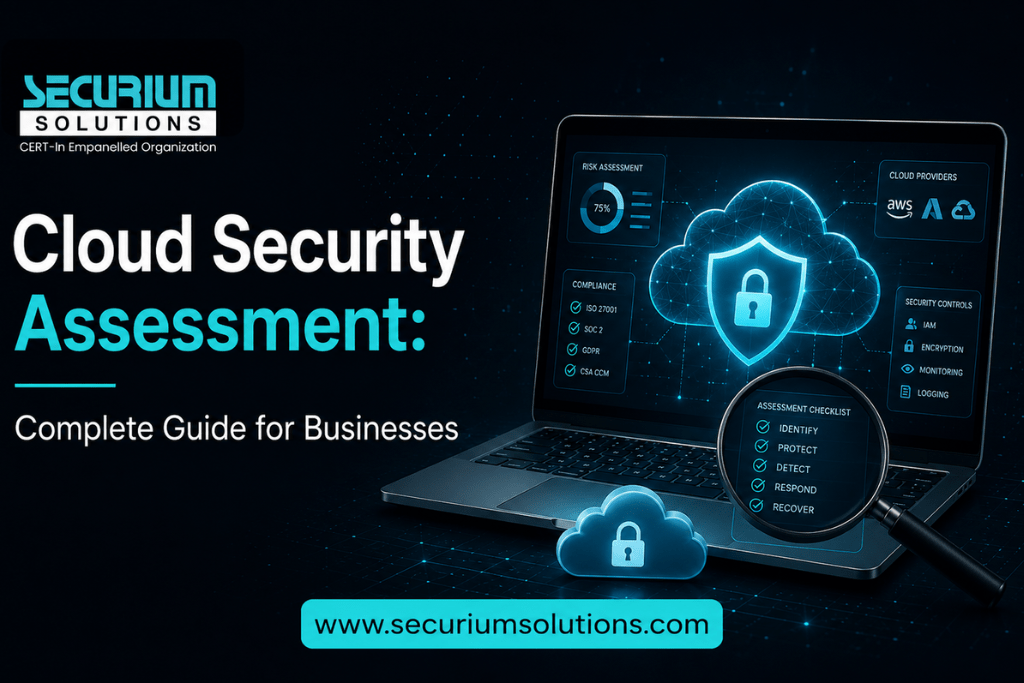
Cloud security assessment is a detailed security review of your cloud environment. It helps businesses find misconfigurations, weak permissions, exposed resources, compliance gaps, and vulnerabilities across cloud platforms.
The main goal is simple: to check whether your cloud infrastructure is secure, properly configured, and ready to handle modern cyber threats.
During a cloud security assessment, experts review important areas such as:
- Cloud accounts
- IAM users and roles
- Access permissions
- Cloud storage
- Cloud databases
- Virtual machines
- Security groups
- Network settings
- Cloud firewalls
- Logging and monitoring
- Encryption settings
- Backup configuration
- API keys and secrets
- Cloud workloads
- Compliance controls
This gives your business a clear view of where your cloud security stands and what needs to be improved.
Why Is Cloud Security Assessment Important?
Many businesses believe that moving to the cloud automatically makes them secure. But cloud security works differently.
Cloud providers like AWS, Azure, and Google Cloud provide strong infrastructure security. However, your business is still responsible for securing users, permissions, data, applications, storage, workloads, and configurations.
This is where mistakes often happen.
A cloud security assessment helps businesses find those mistakes before they turn into serious incidents.
1. Helps Prevent Data Exposure
One of the biggest cloud risks is accidental data exposure. Public storage buckets, open databases, weak access policies, or exposed backups can leak sensitive information.
A cloud assessment helps detect these issues early and gives your team clear steps to fix them.
2. Finds Cloud Misconfigurations
Cloud environments can become complex very quickly. New users, services, servers, databases, and integrations are added regularly.
Because of this, misconfigurations are common.
A proper assessment can identify risky settings such as open ports, public access, weak security groups, missing encryption, and poor network controls.
3. Strengthens Identity and Access Management
In cloud security, access control is one of the most important areas. If users or roles have more permissions than they need, attackers can misuse those permissions after gaining access.
Cloud security assessment checks IAM policies, privileged accounts, access keys, MFA settings, and role permissions to reduce unnecessary risk.
4. Improves Compliance Readiness
Businesses in fintech, healthcare, banking, SaaS, ecommerce, and enterprise sectors often need strong cloud security controls for compliance and client requirements.
A cloud assessment helps identify gaps before formal audits or customer security reviews.
5. Reduces the Risk of Cloud Attacks
Attackers commonly look for exposed cloud services, leaked keys, open storage, weak passwords, and vulnerable workloads.
By finding and fixing these issues early, businesses can reduce the chances of cloud compromise.
Common Cloud Security Risks
Cloud risks are not always obvious. Many systems look normal from the outside but may have weak configurations behind the scenes.
A professional cloud security assessment can identify risks such as:
- Publicly exposed storage buckets
- Weak IAM permissions
- Overprivileged users and roles
- Exposed access keys
- Insecure API keys
- Public cloud databases
- Open security groups
- Unrestricted inbound traffic
- Missing multi-factor authentication
- Weak password policies
- Unencrypted data storage
- Insecure backups
- Poor logging and monitoring
- Missing security alerts
- Misconfigured cloud firewalls
- Exposed virtual machines
- Unpatched cloud workloads
- Insecure container settings
- Poor network segmentation
- Missing disaster recovery controls
- Risky third-party integrations
Some of these issues may look small, but in real-world attacks, small misconfigurations can lead to large data breaches.
Types of Cloud Security Assessment
Every business uses the cloud differently. Some companies use AWS only. Some use Azure. Others use Google Cloud, hybrid cloud, private cloud, or multiple platforms together.
A complete cloud security assessment may include different types of reviews.
AWS Security Assessment
AWS security assessment checks services such as EC2, S3, IAM, RDS, Lambda, VPC, CloudTrail, Security Groups, EBS, CloudWatch, and other AWS resources.
Common AWS risks include public S3 buckets, exposed EC2 instances, weak IAM policies, open security groups, and missing CloudTrail logging.
Azure Security Assessment
Azure security assessment reviews Azure Active Directory, virtual machines, storage accounts, network security groups, databases, subscriptions, key vaults, role-based access, and monitoring controls.
Common Azure risks include excessive permissions, weak identity controls, exposed storage accounts, missing logs, and poor network security settings.
Google Cloud Security Assessment
Google Cloud security assessment checks IAM, Compute Engine, Cloud Storage, VPC, firewall rules, service accounts, databases, logging, and access controls.
Common GCP risks include public buckets, overprivileged service accounts, exposed cloud instances, and weak access policies.
Cloud Network Security Assessment
This focuses on VPCs, subnets, routing, firewall rules, security groups, VPNs, peering connections, and network segmentation.
The goal is to make sure only authorized users and systems can access sensitive cloud resources.
Cloud Compliance Assessment
This review checks whether cloud security controls align with compliance requirements such as ISO 27001, PCI DSS, GDPR, HIPAA, SOC 2, RBI guidelines, or industry-specific security expectations.
Cloud Workload Security Assessment
This focuses on cloud-hosted applications, virtual machines, containers, databases, APIs, and servers.
It helps identify vulnerabilities in the systems running inside your cloud environment.
Cloud Security Assessment Process
A professional cloud security assessment follows a structured process. This makes the review more accurate, safe, and useful for the business.
Step 1: Scope Definition
The first step is to understand what needs to be assessed. This may include cloud accounts, subscriptions, projects, workloads, databases, storage, applications, APIs, and compliance requirements.
A clear scope helps avoid confusion and ensures all important assets are covered.
Step 2: Cloud Architecture Review
Security experts review the overall cloud architecture. They look at how cloud resources are connected, how data flows, which systems are public, and how security controls are placed.
This helps identify design-level risks.
Step 3: Identity and Access Review
IAM is one of the most critical parts of cloud security.
In this step, experts review users, groups, roles, access keys, service accounts, privileged permissions, and MFA settings.
The goal is to reduce excessive access and make sure users only have the permissions they actually need.
Step 4: Configuration Assessment
Cloud configurations are reviewed carefully. This includes storage access, security groups, firewall rules, database exposure, encryption settings, logging, backups, and public access.
This step helps detect mistakes that attackers often try to exploit.
Step 5: Network Security Review
Cloud network settings are checked to identify open ports, unrestricted access, weak segmentation, exposed services, and insecure routing.
Strong network controls help reduce unauthorized access to cloud systems.
Step 6: Data Protection Review
Sensitive data must be protected properly in the cloud.
Experts review encryption, access controls, backup security, storage settings, and data protection practices to reduce the risk of leakage.
Step 7: Logging and Monitoring Review
If something suspicious happens in the cloud, your team should be able to detect it quickly.
This step checks whether logs, alerts, and monitoring systems are properly configured.
Step 8: Vulnerability Identification
Cloud-hosted servers, workloads, applications, and services are reviewed for outdated software, known vulnerabilities, and insecure configurations.
Step 9: Risk Rating
Each finding is rated based on severity, such as Critical, High, Medium, Low, or Informational.
This helps businesses understand what needs urgent attention and what can be fixed later.
Step 10: Reporting
The final report includes all findings, affected cloud resources, screenshots or evidence, business impact, technical impact, and clear remediation steps.
Step 11: Retesting
After your team fixes the issues, retesting is performed to confirm that the risks have been properly resolved.
Cloud Security Assessment vs Cloud Penetration Testing
Many businesses confuse cloud security assessment with cloud penetration testing. Both are useful, but they are not the same.
Cloud security assessment focuses on reviewing cloud configurations, IAM permissions, storage access, network controls, encryption, logging, backups, and compliance gaps.
Cloud penetration testing goes deeper by safely testing whether weaknesses can actually be exploited in a real-world attack scenario.
For stronger cloud security, businesses can use both. A cloud security assessment helps identify gaps, while cloud penetration testing validates how serious those gaps are.
What Should a Cloud Security Assessment Report Include?
A good cloud security assessment report should be easy to understand and practical to use.
It should not only mention what is wrong. It should also explain why it matters and how to fix it.
A professional report should include:
- Executive summary
- Scope of assessment
- Cloud provider details
- Cloud assets reviewed
- Testing methodology
- Security findings
- Misconfiguration details
- Severity rating
- Affected cloud resources
- Business impact
- Technical impact
- Screenshots or evidence
- Remediation steps
- Compliance gaps
- Retesting status
- Final recommendations
For management, the report should explain business risk. For technical teams, it should provide clear steps for remediation.
When Should Businesses Conduct Cloud Security Assessment?
Cloud environments change constantly. New services are added, permissions are modified, applications are deployed, and teams make changes regularly.
Because of this, cloud security assessment should not be a one-time activity.
Businesses should conduct cloud security assessment:
- Before launching cloud-hosted applications
- After cloud migration
- After adding new cloud services
- After major infrastructure changes
- After creating new IAM users or roles
- Before compliance audits
- Before enterprise client onboarding
- After a security incident
- After DevOps or CI/CD changes
- At least once or twice a year
Regular assessment helps businesses stay secure as their cloud environment grows.
Which Businesses Need Cloud Security Assessment?
Any business using cloud services should take cloud security seriously.
Cloud security assessment is especially important for organizations that store sensitive data, run business-critical applications, or operate in regulated industries.
These include:
- Fintech companies
- Banking and finance businesses
- Healthcare organizations
- SaaS companies
- Ecommerce platforms
- EdTech businesses
- Government organizations
- Insurance companies
- Retail companies
- Manufacturing companies
- Telecom companies
- Cloud-native startups
- Enterprises with remote teams
- Businesses using AWS, Azure, or Google Cloud
If your business stores customer data, runs applications in the cloud, uses cloud databases, or manages cloud infrastructure, cloud security assessment should be part of your cybersecurity strategy.
Business Benefits of Cloud Security Assessment
Cloud security assessment is not only a technical activity. It directly supports business protection, compliance, and customer trust.
Better Visibility of Cloud Risk
It helps your team understand where the cloud environment is weak and what should be fixed first.
Stronger Data Protection
It reduces the chances of accidental data exposure through misconfigured storage, weak access controls, or insecure cloud databases.
Improved Compliance Readiness
It supports compliance requirements for industries such as fintech, healthcare, banking, ecommerce, SaaS, and government.
Reduced Risk of Cloud Breaches
By identifying misconfigurations and vulnerabilities early, businesses reduce the chances of cloud compromise.
Better IAM Security
It helps control excessive permissions, privileged access, weak authentication, and risky access keys.
Stronger Client and Partner Trust
Enterprise clients often ask vendors about cloud security. A professional cloud assessment helps build confidence and shows that your business takes security seriously.
Why Choose Securium Solutions for Cloud Security Assessment?
Cloud security requires more than basic configuration checks. It needs a clear understanding of cloud architecture, IAM, networking, storage, monitoring, compliance, and real-world attack methods.
Securium Solutions is a CERT-In Empanelled cybersecurity company offering professional cloud security assessment, VAPT, web application testing, mobile application penetration testing, API penetration testing, network penetration testing, compliance audits, digital forensics, incident response, SOC/SIEM monitoring, and managed security services.
Our expert-led approach helps businesses identify cloud misconfigurations, understand actual risk, and fix security gaps with practical remediation guidance.
Whether your organization uses AWS, Azure, Google Cloud, hybrid cloud, or cloud-hosted applications, Securium Solutions can help secure your cloud infrastructure before attackers exploit it.
The cloud gives businesses speed, flexibility, and growth opportunities. But without proper security controls, it can also expose sensitive data and critical systems.
Cloud security assessment helps businesses find risks in cloud configurations, IAM permissions, storage, networking, workloads, monitoring, and compliance controls.
For modern businesses, cloud security is not optional. It is a key part of data protection, compliance, customer trust, and long-term digital growth.
Need Cloud Security Assessment Services in India?
Securium Solutions helps businesses secure cloud infrastructure through expert-led cloud security assessment, VAPT, API testing, network penetration testing, compliance audits, digital forensics, SOC monitoring, and managed cybersecurity services.
Contact Securium Solutions today to identify and fix cloud security risks before attackers exploit them.
FAQs
What is cloud security assessment?
Cloud security assessment is a security review of your cloud infrastructure. It helps identify misconfigurations, vulnerabilities, weak access controls, and compliance gaps.
Why is cloud security assessment important?
It helps businesses prevent data exposure, fix cloud misconfigurations, strengthen IAM controls, improve compliance readiness, and reduce cyber risk.
Which cloud platforms can be assessed?
Cloud security assessment can be performed for AWS, Microsoft Azure, Google Cloud, private cloud, hybrid cloud, and cloud-hosted infrastructure.
What are common cloud security risks?
Common risks include public storage buckets, weak IAM permissions, exposed access keys, open security groups, public databases, missing MFA, weak encryption, and poor logging.
How often should cloud security assessment be done?
Businesses should conduct cloud security assessment at least once or twice a year. It should also be done after cloud migration, major infrastructure changes, new service deployments, or security incidents.
Who needs cloud security assessment?
Any business using cloud services, cloud storage, cloud databases, cloud-hosted applications, or cloud infrastructure should consider regular cloud security assessment.
Why choose Securium Solutions?
Securium Solutions is a CERT-In Empanelled cybersecurity company offering expert cloud security assessment, VAPT, API testing, compliance audits, digital forensics, incident response, SOC/SIEM monitoring, and managed security services.