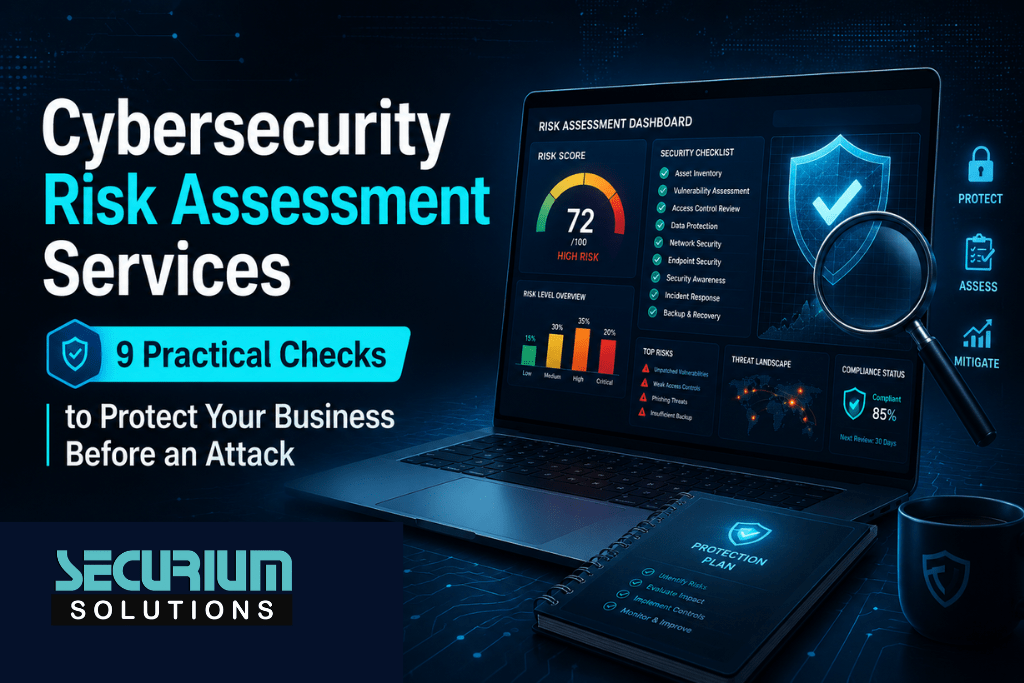
Cybersecurity Risk Assessment Services help businesses understand where they are weak, what can go wrong, and which security risks should be fixed first.
Many businesses know they need cybersecurity.
But they often do not know where to start.
Should they invest in VAPT?
Should they improve cloud security?
Should they enable MFA?
Should they monitor logs?
Should they update policies?
Should they train employees?
Should they fix old systems first?
This is where cybersecurity risk assessment becomes important.
It gives your business a clear picture of current cyber risks and helps you take the right action before an attacker, data breach, ransomware incident, or compliance audit creates pressure.
In simple words, a cybersecurity risk assessment helps you stop guessing and start making security decisions based on real business risk.
Table of Contents
I. What Are Cybersecurity Risk Assessment Services?
II. Why Cybersecurity Risk Assessment Services Matter
III. When Should Businesses Conduct a Cybersecurity Risk Assessment?
IV. Cybersecurity Risk Assessment Services: 9 Practical Checks
V. Cybersecurity Risk Assessment vs VAPT
VI. What Should a Risk Assessment Report Include?
VII. Who We Are
VIII. What We Do
IX. Why We Are Different From Others
X. Which Businesses Need Cybersecurity Risk Assessment Services?
XI. Final Thoughts
XII. FAQs
What Are Cybersecurity Risk Assessment Services?
Cybersecurity Risk Assessment Services are professional security assessments that help businesses identify threats, weak controls, vulnerable systems, exposed data, and possible business impact.
The goal is not only to find technical issues.
The real goal is to understand how cybersecurity gaps can affect your business.
For example, a weak password policy may look like a small issue. But if it leads to email compromise, fake invoice fraud, or customer data leakage, the business impact can become serious.
A risk assessment helps answer three simple questions.
I. What can go wrong?
II. How likely is it to happen?
III. What damage can it cause to the business?
Once these questions are clear, your business can decide what to fix first.
That is the real value of cybersecurity risk assessment.
Why Cybersecurity Risk Assessment Services Matter
Many companies improve cybersecurity only after something bad happens.
A client asks for a security audit.
A data breach happens.
A ransomware attack affects operations.
A cloud server gets exposed.
A phishing email compromises an employee account.
A compliance deadline suddenly creates pressure.
But cybersecurity should not start after damage is done.
Cybersecurity Risk Assessment Services help businesses identify risks early and avoid costly mistakes.
For example, your company may have antivirus protection but no proper backup testing.
You may have a firewall but weak access control.
You may use cloud infrastructure but have public storage buckets.
You may have security policies but employees may not follow them.
You may have important logs, but nobody may be monitoring them.
A risk assessment connects all these areas and shows which weaknesses create the highest business risk.
It helps management, IT teams, compliance teams, and business owners understand the same picture clearly.
Businesses can also refer to the NIST Cybersecurity Framework for a structured approach to understanding and managing cybersecurity risk.
When Should Businesses Conduct a Cybersecurity Risk Assessment?
Cybersecurity risk changes whenever your business changes.
New employees, new applications, new cloud systems, new vendors, new APIs, new customer portals, and new compliance requirements can all create new risks.
A business should conduct a cybersecurity risk assessment in these situations.
I. Before launching a new website, mobile app, API, customer portal, or business application.
II. Before moving important systems, databases, or customer data to the cloud.
III. Before onboarding a large client, vendor, investor, or enterprise partner.
IV. Before preparing for ISO 27001, PCI DSS, SOC 2, HIPAA, GDPR, DPDP readiness, or other compliance requirements.
V. After a cyber incident, ransomware attack, phishing case, fraud incident, or data breach.
VI. After major changes in infrastructure, network, cloud, or application architecture.
VII. Before giving vendors, employees, or remote users access to important systems.
VIII. At least once every year as part of a regular cybersecurity program.
Regular assessments help your business stay prepared instead of reacting in panic.
Cybersecurity Risk Assessment Services: 9 Practical Checks
I. Asset Identification and Business Priority
The first step is to understand what your business needs to protect.
This may include websites, mobile apps, APIs, cloud servers, employee laptops, databases, email accounts, payment systems, customer portals, vendor tools, source code, and internal networks.
But not every asset has the same importance.
A public blog and a customer payment database do not carry the same risk.
A testing server and a live production server do not have the same business impact.
A cybersecurity risk assessment identifies important assets and ranks them based on business criticality.
This helps your team focus on what matters most.
II. Threat Identification
After identifying assets, the next step is to understand what can threaten them.
Threats may come from hackers, ransomware groups, phishing attackers, malicious insiders, careless employees, weak vendors, exposed cloud resources, compromised accounts, or insecure third-party tools.
Every business has a different threat profile.
A fintech company may face payment fraud, API abuse, and compliance risk.
A healthcare organization may face patient data exposure and ransomware risk.
An ecommerce business may face payment fraud, fake orders, account takeover, and customer data leakage.
Threat identification helps your business understand which attack scenarios are most relevant.
III. Vulnerability and Weakness Review
A vulnerability is a weakness that attackers can use.
This may include outdated software, weak passwords, missing MFA, insecure APIs, exposed databases, weak encryption, poor access control, public cloud storage, unpatched servers, and insecure remote access.
A good risk assessment looks at both technical and process-level weaknesses.
For example, a server may be secure, but if employees share admin passwords, the risk is still high.
A cloud database may have encryption, but if access permissions are too open, sensitive data may still be exposed.
This step helps businesses understand where security controls are weak.
IV. Access Control and Identity Risk Review
Access control is one of the most common causes of security incidents.
Many businesses give users more access than they actually need.
Old employee accounts remain active.
Vendors keep access after work is completed.
Admin accounts are shared.
MFA is missing.
Cloud permissions are too broad.
Inactive accounts are not removed.
A cybersecurity risk assessment checks whether the right people have the right level of access.
The goal is simple.
Every user should have only the access required to do their job.
This reduces the risk of insider misuse, account takeover, data leakage, and privilege abuse.
V. Cloud Security Risk Review
Cloud platforms are powerful, but small misconfigurations can create serious exposure.
A cloud risk assessment checks whether cloud resources are configured safely.
This includes IAM permissions, public storage, exposed databases, security groups, encryption, logging, backup protection, access keys, cloud monitoring, and admin accounts.
Many cloud breaches happen because storage buckets are public, access keys are leaked, logs are disabled, or users have unnecessary permissions.
Businesses can also refer to CISA Cybersecurity Best Practices for practical security guidance.
Cloud risk assessment helps businesses reduce accidental exposure and improve control over cloud environments.
VI. Data Protection and Privacy Risk Review
Data is one of the most valuable assets of any business.
A cybersecurity risk assessment checks how sensitive data is collected, stored, processed, shared, backed up, retained, and deleted.
This may include customer data, employee records, payment details, health records, financial documents, source code, contracts, login credentials, and confidential business files.
The assessment checks whether sensitive data is encrypted, access is restricted, backups are protected, and data is not stored longer than required.
If sensitive data is not protected properly, even a small security gap can become a serious data breach.
VII. Network and Endpoint Security Review
Business networks and employee devices are common entry points for attackers.
A cybersecurity risk assessment reviews firewall rules, VPN access, remote desktop exposure, network segmentation, endpoint protection, patch status, risky services, and device hardening.
It also checks whether employee laptops and desktops are protected, updated, monitored, and configured securely.
If one device is compromised, attackers may use it to move deeper into the network.
This is why endpoint security, network segmentation, and monitoring are important for business protection.
VIII. Incident Response Readiness
Many businesses have security tools but no clear plan for what to do during an attack.
When a real incident happens, confusion wastes time.
A cybersecurity risk assessment checks whether your business has an incident response plan, escalation process, evidence preservation steps, communication flow, backup recovery process, and clear responsibilities.
It also checks whether employees know what to do when they see phishing, ransomware, suspicious login alerts, data leakage, or email compromise.
The NIST Computer Security Incident Handling Guide is a useful reference for structured incident handling.
Incident response readiness helps your business reduce damage during real cyberattacks.
IX. Risk Rating and Priority Roadmap
The final step is to rate and prioritize risks.
Not every risk needs the same level of urgency.
Some risks can lead to immediate data breach, business downtime, financial fraud, or compliance failure.
Other risks may be important but not urgent.
A cybersecurity risk assessment rates risks based on likelihood, business impact, asset importance, exploitability, and control weakness.
This helps businesses decide what to fix first.
Without prioritization, teams may spend time on low-risk issues while serious gaps remain open.
A good risk assessment gives a practical roadmap for security improvement.
Cybersecurity Risk Assessment vs VAPT
Cybersecurity risk assessment and VAPT are related, but they are not the same.
Cybersecurity Risk Assessment Services focus on business-level risk.
They look at threats, controls, policies, processes, data protection, access control, compliance gaps, cloud risks, incident readiness, and business impact.
VAPT focuses more on technical testing.
It helps find and validate vulnerabilities in websites, mobile apps, APIs, networks, cloud systems, and applications.
In simple words, VAPT tells you where attackers can break in.
Risk assessment tells you what that weakness means for your business.
For strong cybersecurity, businesses should use both.
VAPT gives technical visibility.
Risk assessment gives business visibility.
Together, they help your organization make smarter security decisions.
What Should a Risk Assessment Report Include?
A professional cybersecurity risk assessment report should be simple, clear, and action-focused.
It should not confuse business owners with unnecessary technical language.
A good report should include the following details.
I. Executive summary explaining the overall cybersecurity risk posture in simple language.
II. Assessment scope covering systems, applications, cloud assets, networks, data, users, and policies reviewed.
III. Asset and data classification based on business importance.
IV. Key threats and realistic risk scenarios relevant to the business.
V. Identified vulnerabilities, control gaps, and process weaknesses.
VI. Risk rating based on likelihood and business impact.
VII. Compliance and policy gaps where applicable.
VIII. Remediation actions that explain what should be fixed.
IX. Priority roadmap showing what needs immediate attention.
X. Final conclusion with practical next steps.
The report should help management understand the risk and help technical teams take action.
Who We Are
Securium Solutions is a CERT-In Empanelled cybersecurity company helping businesses protect digital assets through VAPT, cybersecurity risk assessment, compliance audits, cloud security, digital forensics, incident response, SOC/SIEM monitoring, and managed security services.
We help businesses understand real cyber risks, prioritize security improvements, and reduce exposure before incidents happen.
What We Do
Securium Solutions provides expert-led cybersecurity services for businesses in India and global markets.
Our services include the following.
I. Cybersecurity Risk Assessment Services.
II. VAPT services.
III. Web application penetration testing.
IV. Network penetration testing.
V. Mobile application penetration testing.
VI. API penetration testing.
VII. Cloud security assessment.
VIII. Database security assessment.
IX. Source code review.
X. CERT-In security audit.
XI. Compliance audits.
XII. Digital forensic analysis.
XIII. Incident response.
XIV. SOC/SIEM monitoring.
XV. Managed security services.
You can explore related internal pages here.
I. Securium Solutions Cybersecurity Services
II. CERT-In Empanelled Security Audit
III. Digital Forensic Services
IV. Contact Securium Solutions
Why We Are Different From Others
Securium Solutions focuses on practical risk reduction, not generic checklist reporting.
A real cybersecurity risk assessment should connect technical weaknesses with business impact.
We help businesses understand which risks can lead to data breach, downtime, fraud, compliance failure, financial loss, or reputation damage.
We are different because we combine technical testing, risk analysis, compliance understanding, incident response experience, and business-focused reporting.
As a CERT-In Empanelled cybersecurity company, Securium Solutions helps organizations move from unclear risk to clear security action.
Our goal is not only to identify risk.
Our goal is to help your business reduce it.
Which Businesses Need Cybersecurity Risk Assessment Services?
Any business that uses digital systems, stores sensitive data, processes payments, manages customer accounts, works with vendors, or depends on cloud infrastructure can benefit from Cybersecurity Risk Assessment Services.
These services are especially important for fintech companies, banking and finance businesses, SaaS platforms, ecommerce companies, healthcare organizations, insurance companies, EdTech platforms, payment companies, government vendors, cloud-based businesses, telecom companies, manufacturing companies, retail businesses, and enterprises with customer portals.
If your business depends on technology, cyber risk assessment should be part of your security strategy.
Final Thoughts
Cybersecurity risk is not always visible.
A business may look secure from the outside but still have weak access control, exposed cloud resources, outdated systems, poor logging, missing MFA, weak policies, or untested backups.
Cybersecurity Risk Assessment Services help businesses find these gaps before attackers exploit them.
They help organizations understand risk, prioritize fixes, improve compliance readiness, protect sensitive data, and make smarter cybersecurity decisions.
For modern businesses, cybersecurity risk assessment is not just a technical activity.
It is a business protection strategy.
Need Cybersecurity Risk Assessment Services in India?
Securium Solutions helps businesses identify, assess, and reduce cyber risks through expert-led Cybersecurity Risk Assessment Services, VAPT, cloud security assessment, compliance audits, SOC/SIEM monitoring, incident response, digital forensics, and managed cybersecurity services.
Contact Securium Solutions today to understand your cyber risk, prioritize security improvements, and protect your business before attackers find the gaps.
FAQs
What are Cybersecurity Risk Assessment Services?
Cybersecurity Risk Assessment Services help businesses identify cyber threats, vulnerabilities, weak controls, exposed data, and business risks across applications, networks, cloud systems, users, and processes.
Why do businesses need Cybersecurity Risk Assessment Services?
Businesses need Cybersecurity Risk Assessment Services to understand security gaps, prioritize risks, protect sensitive data, improve compliance readiness, and reduce the chance of cyber incidents.
Is cybersecurity risk assessment the same as VAPT?
No. VAPT focuses on finding and validating technical vulnerabilities. Cybersecurity risk assessment focuses on business impact, control gaps, risk priority, and overall security posture.
How often should businesses conduct cybersecurity risk assessment?
Businesses should conduct cybersecurity risk assessment at least once a year and after major changes such as cloud migration, new application launch, infrastructure changes, compliance audits, or security incidents.
What does a cybersecurity risk assessment report include?
A cybersecurity risk assessment report should include scope, asset classification, threat analysis, vulnerabilities, control gaps, risk rating, business impact, remediation recommendations, and a priority roadmap.
Which businesses need cybersecurity risk assessment?
Fintech, healthcare, ecommerce, SaaS, banking, insurance, EdTech, payment companies, cloud-based businesses, government vendors, and enterprises handling sensitive data should conduct regular cybersecurity risk assessments.
Why choose Securium Solutions?
Securium Solutions is a CERT-In Empanelled cybersecurity company offering Cybersecurity Risk Assessment Services, VAPT, cloud security assessment, compliance audits, SOC/SIEM monitoring, incident response, digital forensics, and managed security services.