Every application starts with code. Whether it is a web application, mobile app, SaaS product, fintech platform, healthcare portal, ecommerce website, or internal business software, the strength of that application depends heavily on how securely the code is written.
The problem is that even a small coding mistake can create a big security risk.
A hardcoded password, weak validation, poor access control, insecure API logic, or badly implemented encryption can give attackers a way to steal data, bypass security, or compromise the application.
That is why secure source code review services in India are becoming important for businesses that want to build safer applications from the beginning.
A source code review helps find security weaknesses directly inside the code before attackers get a chance to exploit them.
What Is Source Code Review?
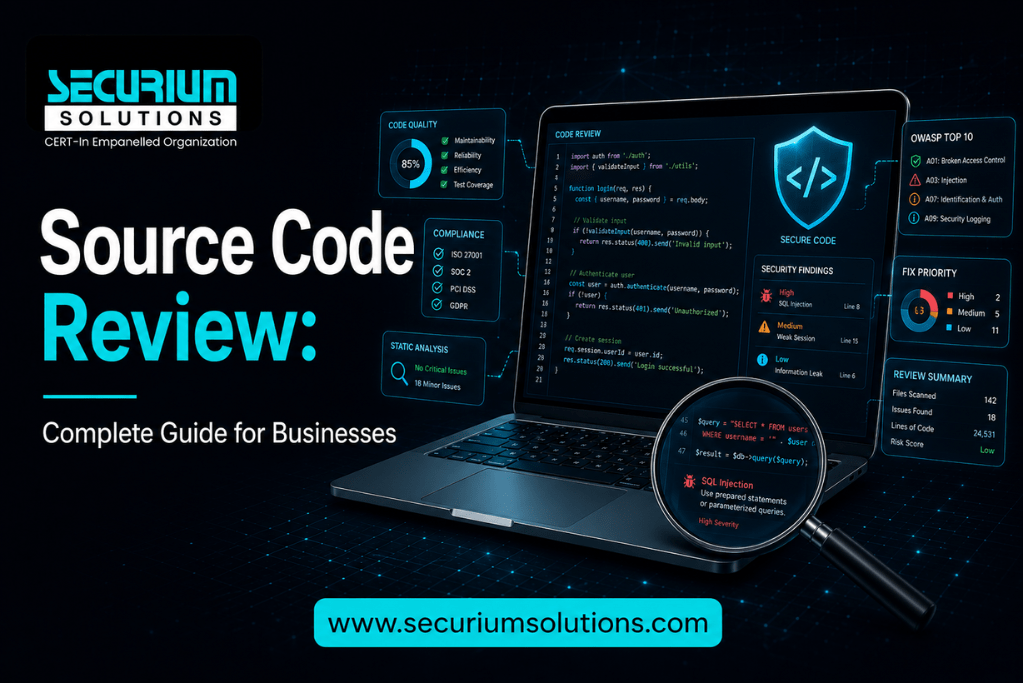
Source code review is a detailed security review of an application’s code. In this process, cybersecurity experts check the code to identify vulnerabilities, insecure coding practices, logic flaws, and security gaps.
The goal is simple: to understand whether the application has been built securely and whether the code can resist common cyberattacks.
During a source code review, experts usually check areas such as:
-
- Authentication logic
- Authorization controls
- Input validation
- Session management
- Password handling
- API security logic
- Database queries
- Encryption implementation
- Error handling
- File upload logic
- Hardcoded secrets
- Access control checks
- Business logic
- Third-party libraries
- Secure coding practices
Unlike normal penetration testing, where testers check the application from the outside, source code review looks inside the application. This helps uncover hidden issues that may not be visible through surface-level testing.
Why Is Source Code Review Important?
Most application vulnerabilities start at the code level. If insecure code reaches production, it can put customer data, business records, and critical systems at risk.
A source code review helps businesses catch these issues early.
1. Finds the Root Cause of Security Issues
Penetration testing can show that a vulnerability exists. Source code review helps explain why it exists.
For example, a pentest may detect broken access control. A code review can show the exact function, file, or logic where the access control check is missing.
This makes fixing the issue much easier for developers.
2. Reduces the Cost of Fixing Vulnerabilities
Security issues are usually easier and cheaper to fix during development than after launch.
Once an application is live, fixing vulnerabilities may require urgent patches, downtime, retesting, and sometimes customer communication. Source code review helps reduce that pressure by finding issues before they become bigger problems.
3. Improves Application Security
A proper code review helps identify weak coding patterns, insecure functions, missing checks, and risky logic.
This helps businesses build applications that are more secure, stable, and reliable.
4. Supports Compliance Requirements
Many industries require businesses to follow secure software development practices.
Source code review can support compliance readiness for standards and frameworks such as ISO 27001, PCI DSS, SOC 2, GDPR, HIPAA, and other security requirements.
5. Helps Developers Write Better Code
A good source code review is not just about finding mistakes. It also helps developers understand secure coding practices.
When developers know what went wrong and how to fix it, they are less likely to repeat the same mistakes in future releases.
Common Vulnerabilities Found During Source Code Review
A professional source code review can uncover issues that automated tools or normal testing may miss.
Common findings include:
-
- Hardcoded passwords
- Hardcoded API keys
- Insecure database queries
- SQL injection risks
- Cross-site scripting risks
- Broken authentication logic
- Broken authorization checks
- Insecure session handling
- Weak password reset logic
- Poor input validation
- Insecure file upload handling
- Weak encryption implementation
- Sensitive data exposure
- Improper error handling
- Insecure logging
- Business logic flaws
- Insecure third-party dependencies
- Missing access control checks
- Use of outdated libraries
- Poor secrets management
- Unsafe deserialization
- Insecure API logic
Some of these issues may look small in the codebase, but in a real-world attack, they can lead to data breaches, account takeover, financial fraud, or complete application compromise.
Manual Code Review vs Automated Code Scanning
Many businesses use automated code scanning tools and believe that is enough. Automated scanning is useful, but it cannot replace expert review.
Automated Code Scanning
Automated tools can quickly scan large codebases and detect common issues. They are helpful for finding insecure functions, outdated libraries, exposed secrets, and known vulnerability patterns.
However, tools can also produce false positives. They may also miss issues that require human understanding, such as business logic flaws or complex access control problems.
Manual Source Code Review
Manual review is done by security experts who understand how attackers think.
They do not just look for patterns. They study how the application works, how users interact with it, and how an attacker may try to abuse the logic.
Manual review is especially useful for finding:
-
- Business logic flaws
- Role-based access control issues
- Authentication bypass risks
- Poor authorization logic
- Insecure payment workflows
- Privilege escalation issues
- Hidden data exposure
- Complex chained vulnerabilities
The best approach is to use both automated scanning and manual source code review.
Automated tools help cover the codebase quickly. Manual review helps find deeper and more business-specific risks.
Source Code Review Process
A professional source code review follows a structured process so the results are clear, accurate, and useful for the business.
Step 1: Scope Definition
The first step is to define what needs to be reviewed.
This may include the application type, programming language, framework, modules, repositories, APIs, user roles, and sensitive workflows.
A clear scope helps the security team focus on the most important parts of the application.
Step 2: Understanding the Codebase
Before reviewing security issues, experts first understand the application structure.
They study the architecture, folder structure, core modules, authentication flow, authorization logic, database interaction, API endpoints, and important business functions.
This helps them review the code in the right context.
Step 3: Automated Scanning
Automated tools may be used to identify common security issues, dependency vulnerabilities, insecure functions, hardcoded secrets, and risky coding patterns.
This step gives reviewers a good starting point for deeper analysis.
Step 4: Manual Security Review
This is one of the most important steps.
Security experts manually review the code to find deeper issues. They check business logic, access controls, input validation, authentication, session handling, API logic, error handling, and sensitive data usage.
Manual review helps identify risks that tools may not understand.
Step 5: Dependency Review
Most applications use third-party libraries, packages, plugins, or frameworks.
These dependencies are checked for known vulnerabilities and outdated versions. Even secure custom code can become risky if the application uses vulnerable third-party components.
Step 6: Secrets and Credential Review
The codebase is checked for hardcoded passwords, API keys, tokens, database credentials, private keys, and other sensitive secrets.
Secrets should never be stored directly inside source code because they can be leaked, misused, or exposed through repositories.
Step 7: Risk Rating
Each finding is rated based on severity, such as Critical, High, Medium, Low, or Informational.
This helps developers and business teams understand which issues need urgent attention.
Step 8: Reporting
The final report includes vulnerability details, affected files, code references, business impact, technical impact, and remediation guidance.
The goal is to make the report useful for both decision-makers and developers.
Step 9: Remediation Support and Retesting
After the development team fixes the issues, retesting can be performed to confirm that the vulnerabilities have been resolved correctly.
What Should a Source Code Review Report Include?
A good source code review report should be clear, practical, and developer-friendly.
It should not only mention the issue. It should explain why the issue matters, where it exists, and how it can be fixed.
A professional report should include:
-
- Executive summary
- Scope of review
- Programming languages and frameworks reviewed
- Testing methodology
- Vulnerability details
- Affected files or modules
- Code references
- Severity rating
- Business impact
- Technical impact
- Proof of concept, where applicable
- Secure coding recommendations
- Remediation steps
- Dependency issues
- Retesting status
- Final security recommendations
For business leaders, the report should explain the risk in simple terms. For developers, it should provide enough technical detail to fix the issue properly.
When Should Businesses Conduct Source Code Review?
Source code review should not be treated as a last-minute security activity. It works best when included throughout the software development lifecycle.
Businesses should conduct source code review:
-
- Before launching a new application
- Before major product releases
- After major code changes
- Before compliance audits
- Before enterprise client onboarding
- After adding payment features
- After integrating third-party APIs
- After changing authentication or authorization logic
- After a security incident
- During secure SDLC implementation
- At least once or twice a year
Regular code review helps businesses reduce risk before vulnerabilities reach production.
Which Businesses Need Source Code Review?
Any business that builds or manages software should consider source code review.
It is especially important for:
-
-
- Fintech companies
- Banking and finance businesses
- SaaS platforms
- Ecommerce businesses
- Healthcare applications
- EdTech platforms
- Government applications
- Insurance platforms
- Payment applications
- Enterprise software companies
- Mobile app companies
- Cloud-based businesses
- Startups preparing for enterprise clients
- Companies handling sensitive user data
-
If your application handles login, payments, APIs, dashboards, customer records, personal data, or business-critical workflows, secure source code review is highly recommended.
Source Code Review vs Penetration Testing
Source code review and penetration testing both improve application security, but they work in different ways.
Penetration testing checks the application from the attacker’s point of view. Testers interact with the live application to find vulnerabilities that can be exploited.
Source code review checks the application from the inside. It helps identify insecure code, weak logic, missing checks, and hidden flaws.
For strong application security, businesses should use both.
Penetration testing shows what can be exploited. Source code review helps explain why the issue exists and how to fix it from the root.
Business Benefits of Source Code Review
Source code review gives businesses both technical and practical value.
Stronger Application Security
It helps remove vulnerabilities before they reach production and become real business risks.
Lower Remediation Cost
Finding issues early reduces the time, effort, and cost required to fix them later.
Better Developer Awareness
Developers learn from the findings and improve their secure coding habits over time.
Improved Compliance Readiness
Source code review supports secure software development requirements and helps businesses prepare for audits.
Reduced Risk of Data Breaches
Fixing code-level vulnerabilities reduces the chances of data leakage, account takeover, unauthorized access, and application compromise.
Better Client Confidence
For SaaS companies, fintech platforms, and enterprise software providers, secure code review can help build trust with clients, partners, and investors.
Why Choose Securium Solutions for Source Code Review?
Choosing the right cybersecurity partner matters because source code review requires more than tool-based scanning. It needs secure coding knowledge, business logic understanding, real-world attack experience, and practical remediation guidance.
Securium Solutions is a CERT-In Empanelled cybersecurity company offering professional source code review, VAPT, web application penetration testing, mobile application testing, API penetration testing, network penetration testing, cloud security assessment, compliance audits, digital forensics, incident response, SOC/SIEM monitoring, and managed security services.
Our expert-led approach helps businesses identify insecure code, understand actual risk, and fix vulnerabilities with clear remediation steps.
Whether you are building a SaaS platform, fintech application, ecommerce system, healthcare portal, mobile app, or enterprise software, Securium Solutions can help secure your code before attackers exploit it.
Final Thoughts
Secure applications start with secure code.
If vulnerabilities exist inside the codebase, they may eventually become serious security issues after deployment. Source code review helps businesses find these weaknesses early and fix them properly.
It also helps development teams improve coding practices, reduce future mistakes, and build stronger applications.
For modern businesses, secure source code review is not just a technical check. It is a smart investment in application security, customer trust, compliance, and long-term business protection.
Need Secure Source Code Review Services in India?
Securium Solutions helps businesses secure applications through expert-led source code review, VAPT, web application testing, API testing, mobile app testing, cloud security assessments, compliance audits, digital forensics, SOC monitoring, and managed cybersecurity services.
Contact Securium Solutions today to identify and fix code-level vulnerabilities before attackers exploit them.
FAQs
What is source code review?
Source code review is a security assessment where experts review application code to identify vulnerabilities, insecure coding practices, logic flaws, and security gaps.
Why is source code review important?
It helps businesses find vulnerabilities at the code level, reduce security risk, improve application security, and fix issues before deployment.
Is source code review better than penetration testing?
Both are important. Penetration testing checks the application from the outside, while source code review checks the internal code to find root causes and hidden flaws.
What vulnerabilities are found during source code review?
Common findings include hardcoded secrets, SQL injection risks, weak authentication, broken authorization, insecure APIs, poor input validation, weak encryption, and business logic flaws.
When should source code review be done?
Source code review should be done before launch, before major releases, after major code changes, before compliance audits, and at least once or twice a year.
Who needs source code review?
Any business building web apps, mobile apps, SaaS platforms, APIs, fintech systems, ecommerce platforms, or enterprise software should consider source code review.
Why choose Securium Solutions?
Securium Solutions is a CERT-In Empanelled cybersecurity company offering expert source code review, VAPT, web application testing, API testing, cloud security, compliance audits, incident response, and managed security services.