Data is one of the most valuable assets a business owns. Customer records, payment information, employee details, financial reports, healthcare records, login credentials, business documents, and application data are often stored inside databases.
But when databases are not secured properly, they can become a direct target for attackers.
Sometimes, the risk comes from something simple — a weak password, an exposed database port, excessive user permissions, missing encryption, or an old database version that has not been patched. These small gaps can lead to serious problems such as data breaches, financial loss, compliance issues, and damage to customer trust.
That is why database security assessment services in India are becoming important for businesses that want to protect sensitive data and reduce cyber risk.
A database security assessment helps businesses understand where their database security is weak and what needs to be fixed before attackers take advantage of it.
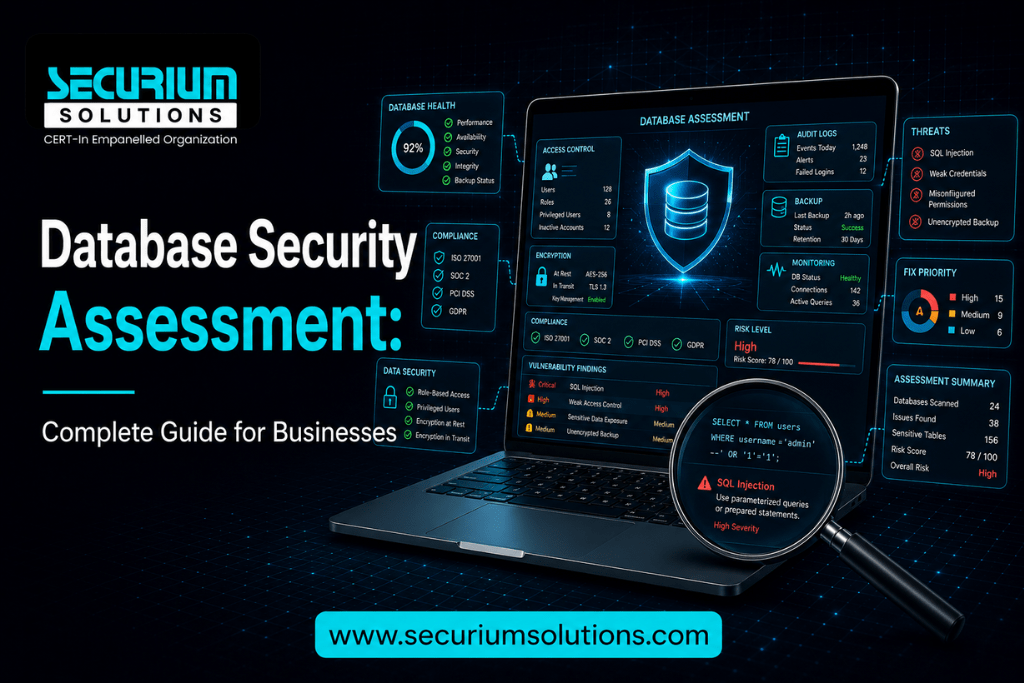
What Is Database Security Assessment?
Database security assessment is a detailed review of your database environment to identify security gaps, misconfigurations, weak access controls, missing encryption, backup risks, and compliance-related issues.
The main purpose is simple: to check whether your database is protected against unauthorized access, data leakage, privilege misuse, and cyberattacks.
During a database security assessment, experts usually review areas such as:
-
- Database configuration
- User accounts and roles
- Access permissions
- Password policies
- Database ports and services
- Encryption settings
- Backup security
- Patch levels
- Authentication controls
- Logging and monitoring
- Privileged access
- Sensitive data storage
- Cloud database settings
- Compliance controls
This gives your business a clear picture of how secure your database environment really is.
Why Is Database Security Assessment Important?
Most businesses depend on databases every day, but database security is often ignored until something goes wrong.
The problem is that databases usually hold sensitive and business-critical information. If attackers gain access, they may steal data, change records, delete information, or disrupt operations.
A database security assessment helps you find these risks early.
1. Protects Sensitive Business Data
Databases may contain customer details, payment records, health information, employee data, login credentials, and confidential business files.
A proper assessment helps ensure this information is not exposed through weak permissions, unsafe configurations, or poor security controls.
2. Finds Hidden Misconfigurations
Many database security issues happen because of simple configuration mistakes.
Examples include open ports, default credentials, exposed admin interfaces, weak access rules, or unnecessary services running in the background.
A database security assessment helps detect these issues before attackers find them.
3. Reduces the Risk of Data Breaches
A database breach can cause financial loss, legal problems, compliance penalties, customer complaints, and serious brand damage.
By finding vulnerabilities early, businesses can reduce the chances of database compromise.
4. Strengthens Access Control
Not every user needs full access to the database.
A database assessment reviews user roles, admin privileges, application accounts, third-party access, and permission levels. This helps ensure that people and systems only have the access they actually need.
5. Improves Compliance Readiness
Industries such as fintech, healthcare, banking, ecommerce, SaaS, insurance, and government often need strong database security controls for audits and client requirements.
A database security assessment helps identify gaps before a formal audit or security review.
Common Database Security Risks
Database risks are not always easy to see. A database may look normal from the outside but still have weak settings inside.
Some common database security risks include:
-
- Weak database passwords
- Default database credentials
- Excessive user permissions
- Publicly exposed database ports
- Unpatched database versions
- Missing encryption
- Insecure backups
- Poor access control
- Weak authentication
- Lack of multi-factor authentication
- Unnecessary database services
- SQL injection risks
- Poor logging and monitoring
- Missing audit trails
- Insecure database connections
- Sensitive data stored in plain text
- Misconfigured cloud databases
- Overprivileged admin accounts
- Lack of database activity monitoring
- Poor backup retention controls
- Unauthorized third-party access
Some of these issues may seem small, but attackers often combine multiple small weaknesses to create a bigger attack path.
Types of Database Security Assessment
Every business uses databases differently. Some use on-premise databases. Some use cloud databases. Others use managed database services or hybrid environments.
A complete database security assessment may include different types of reviews.
SQL Database Security Assessment
This includes databases such as MySQL, PostgreSQL, Microsoft SQL Server, Oracle Database, and MariaDB.
The review focuses on database configuration, patching, encryption, access control, user permissions, database queries, and security settings.
NoSQL Database Security Assessment
NoSQL databases such as MongoDB, Cassandra, Redis, CouchDB, and Elasticsearch are widely used in modern applications.
Security assessment checks for exposed instances, weak authentication, poor access controls, insecure APIs, and data exposure risks.
Cloud Database Security Assessment
Many businesses now use cloud databases such as Amazon RDS, Azure SQL Database, Google Cloud SQL, DynamoDB, Cosmos DB, and managed MongoDB services.
Cloud database assessment reviews public exposure, IAM permissions, encryption, backups, network access, logging, and cloud-specific security controls.
Database Configuration Review
This focuses on database settings, default accounts, password policies, exposed services, unsafe features, and unnecessary database functions.
The goal is to identify weak configurations that could create security risks.
Database Access Control Review
This review checks users, roles, privileges, admin accounts, application accounts, and third-party access.
It helps ensure that every user has only the permissions required for their role.
Database Backup Security Review
Backups are often overlooked, but they can contain the same sensitive data as the live database.
A backup security review checks whether backups are encrypted, access-controlled, securely stored, and protected from unauthorized access.
Database Security Assessment Process
A professional database security assessment follows a clear process so the results are useful, accurate, and easy to act on.
Step 1: Scope Definition
The first step is to decide which databases and environments need to be reviewed.
This may include production databases, staging databases, cloud databases, backup systems, database servers, connected applications, and user access.
Step 2: Database Architecture Review
Experts review how the database is connected with applications, users, networks, APIs, cloud services, and backup systems.
This helps identify risky connections, weak design areas, and possible exposure points.
Step 3: Configuration Review
Database configurations are checked carefully to identify weak settings, default options, exposed services, unsafe features, and insecure parameters.
This step helps uncover mistakes that attackers commonly try to exploit.
Step 4: Access Control Review
User accounts, admin roles, application accounts, third-party users, and permissions are reviewed.
The goal is to reduce unnecessary access and follow the principle of least privilege.
Step 5: Authentication and Password Review
Authentication controls are checked to see whether they are strong enough.
This includes password policies, account lockout settings, credential management, and multi-factor authentication where applicable.
Step 6: Encryption Review
Sensitive data should be protected both at rest and in transit.
In this step, experts check whether encryption is properly configured for database storage, backups, and database connections.
Step 7: Patch and Version Review
Outdated database versions may contain known vulnerabilities.
Security experts review database versions, patch levels, unsupported software, and known security risks.
Step 8: Logging and Monitoring Review
Database logs are important for detecting suspicious activity.
This step checks whether logging, audit trails, alerts, and monitoring controls are properly enabled and useful during incident investigation.
Step 9: Backup Security Review
Backups are reviewed to make sure they are encrypted, access-controlled, securely stored, and recoverable when needed.
A backup is only useful if it is both secure and reliable.
Step 10: Risk Rating
Each finding is rated based on severity, such as Critical, High, Medium, Low, or Informational.
This helps businesses understand which issues need immediate attention.
Step 11: Reporting
The final report includes findings, affected database systems, risk levels, business impact, technical details, evidence, and remediation steps.
A good report should help both management and technical teams take action.
Step 12: Retesting
After the issues are fixed, retesting can be done to confirm that the risks have been properly resolved.
Database Security Assessment vs Database Penetration Testing
Database security assessment and database penetration testing are closely related, but they are not the same.
Database security assessment focuses on reviewing configurations, permissions, encryption, backups, patching, logging, and compliance gaps.
Database penetration testing goes one step further by safely testing whether database weaknesses can be exploited in a real attack scenario.
For stronger database protection, businesses can use both.
An assessment helps you find the gaps. Penetration testing helps confirm how serious those gaps are.
What Should a Database Security Assessment Report Include?
A database security assessment report should be clear, practical, and easy to understand.
It should explain what the issue is, why it matters, which systems are affected, and how the issue can be fixed.
A professional report should include:
-
- Executive summary
- Scope of assessment
- Database systems reviewed
- Database versions and platforms
- Testing methodology
- Security findings
- Misconfiguration details
- Access control issues
- Severity rating
- Business impact
- Technical impact
- Screenshots or evidence
- Remediation steps
- Compliance gaps
- Backup security observations
- Retesting status
- Final recommendations
For business leaders, the report should explain the risk in simple language. For technical teams, it should provide clear remediation steps.
When Should Businesses Conduct Database Security Assessment?
Database security should not be reviewed only after an incident. It should be checked regularly because databases change over time.
New users, new applications, cloud migrations, integrations, backups, and permission changes can introduce new risks.
Businesses should conduct database security assessment:
-
- Before launching a new application
- After database migration
- After cloud migration
- After adding new database users
- After changing access permissions
- After major application updates
- Before compliance audits
- Before enterprise client onboarding
- After a security incident
- After integrating third-party systems
- At least once or twice a year
Regular assessment helps keep sensitive business data protected as systems grow.
Which Businesses Need Database Security Assessment?
Any business that stores sensitive or business-critical data should consider database security assessment.
It is especially important for:
-
- Fintech companies
- Banking and finance businesses
- Healthcare organizations
- Ecommerce businesses
- SaaS platforms
- EdTech companies
- Insurance companies
- Government organizations
- Retail companies
- Manufacturing companies
- Telecom companies
- Payment companies
- Cloud-based businesses
- Enterprises with customer databases
If your database stores customer records, payment details, health data, employee information, login credentials, business documents, or application data, database security assessment is highly recommended.
Business Benefits of Database Security Assessment
Database security assessment is not only a technical activity. It directly supports business protection, compliance, and customer trust.
Stronger Data Protection
It helps protect sensitive customer and business data from unauthorized access, leakage, or misuse.
Lower Risk of Data Breaches
By finding weak configurations and access issues early, businesses reduce the chances of database compromise.
Better Compliance Readiness
Database security assessment supports compliance needs for industries such as fintech, healthcare, banking, ecommerce, SaaS, and government.
Improved Access Control
It helps ensure users, applications, and third parties have only the access they actually need.
Better Backup Security
It checks whether database backups are protected, encrypted, and stored securely.
Stronger Customer Trust
Customers and enterprise clients expect businesses to protect their data. A secure database environment helps build that trust.
Why Choose Securium Solutions for Database Security Assessment?
Database security requires more than a basic checklist. It needs a strong understanding of database platforms, access controls, cloud environments, encryption, compliance, and real-world attack techniques.
Securium Solutions is a CERT-In Empanelled cybersecurity company offering professional database security assessment, VAPT, web application testing, mobile application testing, API penetration testing, network penetration testing, cloud security assessment, compliance audits, digital forensics, incident response, SOC/SIEM monitoring, and managed security services.
Our expert-led approach helps businesses identify database risks, understand actual impact, and fix security gaps with practical remediation guidance.
Whether your organization uses SQL databases, NoSQL databases, cloud databases, managed database services, or hybrid database environments, Securium Solutions can help secure your critical data before attackers exploit it.
Final Thoughts
Databases hold some of the most important information a business has. If they are not secured properly, they can become a direct path to data breaches, fraud, compliance problems, and business disruption.
A database security assessment helps businesses find hidden risks in configurations, access controls, encryption, backups, logging, and database architecture.
For modern businesses, database security is not optional. It is essential for protecting data, meeting compliance requirements, maintaining customer trust, and supporting long-term business safety.
Need Database Security Assessment Services in India?
Securium Solutions helps businesses secure critical data through expert-led database security assessment, VAPT, cloud security assessment, API testing, compliance audits, digital forensics, SOC monitoring, and managed cybersecurity services.
Contact Securium Solutions today to identify and fix database security risks before attackers exploit them.
FAQs
What is database security assessment?
Database security assessment is a security review of database systems to identify misconfigurations, weak access controls, vulnerabilities, encryption gaps, and compliance issues.
Why is database security assessment important?
It helps businesses protect sensitive data, reduce breach risk, strengthen access control, improve compliance readiness, and secure database environments.
What databases can be assessed?
Database security assessment can be performed for SQL databases, NoSQL databases, cloud databases, managed databases, and hybrid database environments.
What are common database security risks?
Common risks include weak passwords, excessive permissions, exposed database ports, missing encryption, unpatched versions, insecure backups, and poor logging.
How often should database security assessment be done?
Businesses should conduct database security assessment at least once or twice a year and after migrations, major updates, access changes, or security incidents.
Who needs database security assessment?
Any business storing customer data, financial records, health data, employee information, login credentials, or business-critical information should consider database security assessment.
Why choose Securium Solutions?
Securium Solutions is a CERT-In Empanelled cybersecurity company offering expert database security assessment, VAPT, cloud security, API testing, compliance audits, incident response, SOC/SIEM monitoring, and managed security services.