Quick Answer: What Is Digital Forensic Analysis?
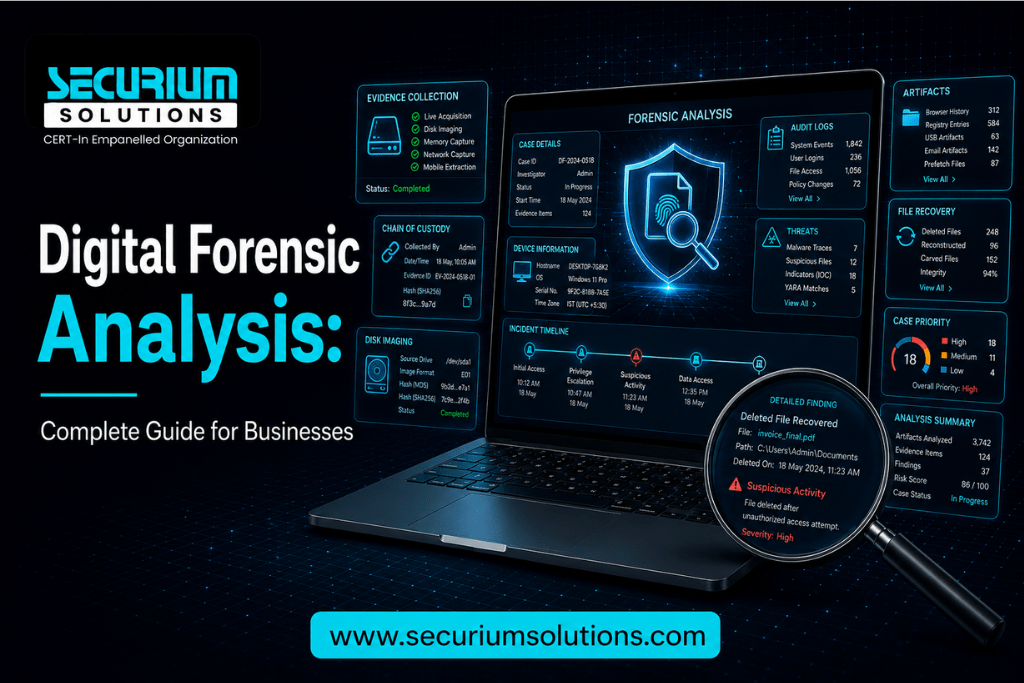
Digital forensic analysis is the process of finding, preserving, and examining digital evidence after a cyber incident. It helps businesses understand what happened, how it happened, which systems were affected, whether data was stolen, and what steps should be taken next.
For example, if your company faces ransomware, email fraud, data theft, malware infection, insider activity, or unauthorized access, digital forensics helps uncover the real story behind the incident.
In simple words, digital forensics gives businesses facts, evidence, and clarity when something suspicious happens in their digital environment.
Why Digital Forensics Matters for Businesses
When a cyber incident happens, many businesses feel confused and rushed. The first reaction is usually to fix the problem quickly. But if systems are formatted, logs are deleted, emails are removed, or devices are reused, important evidence can be lost forever.
That is why digital forensic analysis is so important.
It helps businesses answer critical questions like:
-
- What exactly happened?
- How did the attacker get in?
- Was any data stolen?
- Which systems or accounts were affected?
- Was an employee or insider involved?
- Is there evidence for legal or internal action?
- How can we stop this from happening again?
For businesses, digital forensics is not just a technical investigation. It is a way to protect evidence, reduce damage, support decision-making, and improve future security.
What Is Digital Forensic Analysis?
Digital forensic analysis is a structured investigation of digital devices, systems, accounts, and logs to identify evidence related to a cyber incident or suspicious activity.
It may involve examining:
-
- Computers and laptops
- Mobile devices
- Servers
- Emails
- Cloud accounts
- Hard drives
- Network logs
- Firewall logs
- Endpoint logs
- Databases
- Storage devices
- Malware files
- User activity records
The main goal is to collect and analyze digital evidence in a way that is accurate, reliable, and useful for business, legal, HR, compliance, or law enforcement purposes.
When Does a Business Need Digital Forensic Analysis?
A business may need digital forensics whenever there is suspicious digital activity or a confirmed cyber incident.
Common situations include:
-
- Ransomware attack
- Email fraud
- Business email compromise
- Data theft
- Data leakage
- Malware infection
- Unauthorized login
- Suspicious employee activity
- Insider threat suspicion
- Deleted or modified files
- Financial fraud
- Cloud account compromise
- Server compromise
- Customer data exposure
- Cyber incident requiring evidence
- Legal or internal investigation
The sooner digital forensic experts are involved, the better the chances of preserving useful evidence.
Why Businesses Should Not Ignore Digital Evidence
After a cyber incident, every action matters.
If someone restarts a system, deletes emails, clears browser history, removes malware, or formats a laptop without proper investigation, important evidence may disappear.
Digital forensic analysis helps protect that evidence before it is lost or changed.
This is especially important when the case involves:
-
- Legal action
- Employee misconduct
- Cyber fraud
- Insurance claims
- Customer data exposure
- Regulatory reporting
- Internal investigation
- Law enforcement complaint
Proper evidence handling gives businesses a stronger foundation for decision-making.
Common Cases Where Digital Forensics Helps
1. Ransomware Attacks
Ransomware can lock business files, stop operations, and create panic.
Digital forensics helps investigate:
-
- How ransomware entered the system
- Which files and systems were affected
- Whether attackers moved inside the network
- Whether data was copied before encryption
- What malware behavior was observed
- What security gaps allowed the attack
This helps businesses recover better and reduce the chance of another ransomware incident.
2. Email Fraud and Business Email Compromise
Email fraud is one of the most common problems businesses face.
Attackers may compromise an email account and use it to send fake payment instructions, change invoice details, redirect funds, or steal confidential communication.
Digital forensic experts can analyze:
-
- Email headers
- Login history
- Suspicious IP addresses
- Mailbox forwarding rules
- Deleted emails
- Fake domains
- Phishing links
- Unauthorized mailbox activity
This helps businesses understand whether the email account was compromised and how the fraud happened.
3. Data Theft or Data Leakage
If confidential business files, customer data, source code, financial records, or internal documents are leaked, digital forensics can help trace the activity.
Experts may check:
-
- File access history
- USB device usage
- Cloud uploads
- Email attachments
- Deleted files
- User login records
- System activity logs
This helps identify how the data left the organization and who may have accessed it.
4. Insider Threat Investigation
Sometimes the threat comes from inside the company.
A current or former employee may copy files, misuse access, delete records, share confidential information, or use company data without permission.
Digital forensic analysis can help investigate:
-
- User activity
- File transfers
- USB usage
- Email activity
- Cloud storage activity
- Login patterns
- Deleted files
- System access history
This gives businesses evidence to support internal or legal action.
5. Malware Infection
Malware can steal data, monitor activity, damage systems, or give attackers remote access.
Digital forensic analysis helps identify:
-
- How the malware entered
- What files were affected
- Whether data was stolen
- Whether the malware created persistence
- What external servers it contacted
- How the infection spread
This helps businesses remove the threat properly and strengthen security controls.
6. Unauthorized Access
If your business notices unknown logins, suspicious account activity, unusual server access, or changes in critical systems, digital forensics can help trace the activity.
Experts can review:
-
- Login records
- IP addresses
- Device information
- Access timestamps
- Failed login attempts
- Privilege changes
- System logs
This helps confirm whether the access was accidental, internal, or malicious.
Types of Digital Forensic Analysis
Digital forensics is not limited to one device or one system. Different cases need different types of investigation.
Computer Forensics
Computer forensics focuses on laptops, desktops, hard drives, operating systems, files, deleted data, browser history, installed applications, and user activity.
It is useful for employee investigations, data theft cases, malware infections, and unauthorized access cases.
Mobile Forensics
Mobile forensics focuses on smartphones and tablets.
Depending on technical and legal limitations, it may include analysis of messages, call logs, app data, photos, files, browsing history, location data, and deleted content.
Email Forensics
Email forensics helps investigate phishing, spoofing, business email compromise, fake invoices, suspicious attachments, and unauthorized mailbox access.
It may include email header analysis, login review, forwarding rule checks, and suspicious email trail investigation.
Network Forensics
Network forensics focuses on network traffic, firewall logs, server logs, intrusion alerts, and communication between systems.
It helps identify attacker movement, suspicious connections, malware communication, and possible data exfiltration.
Cloud Forensics
Cloud forensics is important for businesses using platforms like AWS, Azure, Google Cloud, Microsoft 365, Google Workspace, or SaaS tools.
It involves reviewing cloud logs, access records, user activity, storage access, and cloud account behavior.
Malware Forensics
Malware forensics focuses on understanding malicious files and infected systems.
It helps identify what the malware did, how it entered, whether it stole data, and how it can be removed safely.
Disk and Data Forensics
This includes disk imaging, deleted file recovery, metadata review, file system analysis, and evidence preservation from storage devices.
It is useful in legal, corporate, and cybercrime investigations.
Digital Forensic Analysis Process
A professional digital forensic investigation follows a careful process. This helps protect evidence and produce reliable findings.
Step 1: Understanding the Incident
The first step is to understand the situation.
Experts collect basic information such as:
-
- What happened?
- When was it noticed?
- Which systems are involved?
- What actions have already been taken?
- What does the business want to investigate?
This helps define the direction of the investigation.
Step 2: Identifying Evidence Sources
Next, experts identify where useful evidence may exist.
This may include:
-
- Laptops
- Desktops
- Servers
- Mobile devices
- Email accounts
- Cloud accounts
- Firewall logs
- Endpoint logs
- Database logs
- Storage devices
- Network records
Step 3: Preserving Evidence
Evidence must be handled carefully.
This may include creating forensic images, collecting logs, securing devices, documenting evidence handling, and preventing unnecessary changes to systems.
Proper preservation is important because careless handling can damage or overwrite useful data.
Step 4: Collecting Data
Forensic experts collect relevant data from devices, systems, emails, logs, cloud platforms, and storage media.
The collection method depends on the case type, business environment, and legal requirements.
Step 5: Examining the Evidence
The collected evidence is examined using forensic methods and tools.
Experts may analyze:
-
- Deleted files
- Timestamps
- Login activity
- File access
- USB usage
- Browser history
- Malware traces
- Cloud access logs
- Email trails
- System events
Step 6: Creating a Timeline
A timeline helps connect the dots.
It shows when the incident started, what actions happened, which systems were affected, and how the event progressed.
This is often one of the most useful parts of a forensic investigation.
Step 7: Finding the Root Cause
Root cause analysis helps identify how the incident happened.
The cause may be:
-
- Phishing email
- Weak password
- Malware infection
- Exposed server
- Compromised account
- Insider activity
- Misconfigured system
- Unpatched software
Finding the root cause helps the business fix the actual weakness.
Step 8: Assessing the Impact
The investigation checks what damage may have occurred.
This may include:
-
- Data accessed
- Files copied
- Systems compromised
- Accounts misused
- Malware activity
- Business operations affected
This helps the business understand the seriousness of the incident.
Step 9: Preparing the Report
The final report explains the findings in a clear and structured way.
It may include evidence, timeline, root cause, affected systems, indicators of compromise, technical observations, business impact, and recommendations.
Step 10: Giving Remediation Guidance
After the investigation, businesses receive practical guidance on what to fix.
This may include improving access controls, resetting credentials, patching systems, improving monitoring, strengthening email security, or updating incident response plans.
What Should a Digital Forensic Report Include?
A good forensic report should be clear, evidence-based, and easy to understand.
It should include:
-
- Executive summary
- Case background
- Scope of investigation
- Evidence sources examined
- Investigation methodology
- Timeline of events
- Key findings
- Root cause analysis
- Affected systems or accounts
- Indicators of compromise
- Evidence details
- Screenshots or technical artifacts
- Business impact
- Data exposure observations
- Recommendations
- Final conclusion
In sensitive cases, the report may also support legal, HR, compliance, or law enforcement actions.
Digital Forensics vs Incident Response
Digital forensics and incident response are closely related, but they are not the same.
Incident response focuses on immediate action. It helps contain the attack, stop further damage, remove threats, recover systems, and restore operations.
Digital forensics focuses on investigation. It helps understand what happened, how it happened, what evidence exists, and what impact the incident had.
For serious cyber incidents, businesses often need both.
Incident response helps the business recover. Digital forensics helps the business understand the truth behind the incident.
Which Businesses Need Digital Forensic Services?
Digital forensic services are useful for any organization that uses digital systems or handles sensitive information.
They are especially important for:
-
-
- Fintech companies
- Banking and finance businesses
- Healthcare organizations
- SaaS companies
- Ecommerce businesses
- Insurance companies
- Government organizations
- Educational institutions
- Legal firms
- Manufacturing companies
- Retail businesses
- Telecom companies
- Enterprises with remote teams
- Businesses handling confidential data
-
If your business uses computers, emails, cloud systems, mobile devices, databases, or online platforms, digital forensic readiness should be part of your cybersecurity plan.
Business Benefits of Digital Forensic Analysis
Digital forensics gives businesses clarity during stressful situations.
Clear Understanding of What Happened
It helps businesses avoid guesswork and understand the incident based on real evidence.
Better Evidence Preservation
It protects digital evidence that may be needed for legal, compliance, HR, or internal investigation purposes.
Stronger Root Cause Identification
It helps identify the real reason behind the incident so the business can fix the correct issue.
Lower Risk of Repeat Incidents
By understanding how the incident happened, businesses can improve controls and reduce future risk.
Support for Legal and Internal Action
Forensic findings can support legal disputes, employee misconduct cases, fraud matters, and cybercrime complaints.
Better Cybersecurity Planning
The investigation helps businesses improve monitoring, access control, endpoint security, email security, backups, and incident response planning.
Why Choose Securium Solutions for Digital Forensic Analysis?
Digital forensic analysis requires experience, technical skill, careful evidence handling, and a clear understanding of cyber threats.
Securium Solutions is a CERT-In Empanelled cybersecurity company offering professional digital forensic analysis, cyber fraud investigation, email fraud investigation, malware analysis, data recovery, disk imaging, incident response, VAPT, compliance audits, cloud security assessment, SOC/SIEM monitoring, and managed security services.
Our expert-led approach helps businesses investigate cyber incidents, preserve digital evidence, identify root causes, and take practical steps to reduce future risk.
Whether your organization is dealing with ransomware, email fraud, insider activity, data theft, malware infection, or unauthorized access, Securium Solutions can help you investigate the incident with clarity and confidence.
Final Thoughts
When a cyber incident happens, businesses need facts, not assumptions.
Digital forensic analysis helps uncover what happened, how it happened, which systems were affected, and what evidence is available.
It also helps businesses improve security and reduce the chances of similar incidents in the future.
For modern organizations, digital forensics is not only useful after an attack. It is an important part of cyber resilience, legal readiness, compliance, and business protection.
Need Digital Forensic Analysis Services in India?
Securium Solutions helps businesses investigate cyber incidents through expert-led digital forensic analysis, cyber fraud investigation, malware analysis, email fraud investigation, data recovery, incident response, and managed cybersecurity services.
Contact Securium Solutions today to investigate suspicious activity, preserve digital evidence, and protect your business from future cyber risks.
FAQs
What is digital forensic analysis?
Digital forensic analysis is the process of collecting, preserving, examining, and analyzing digital evidence to investigate cyber incidents, fraud, data theft, malware infection, or suspicious activity.
Why do businesses need digital forensics?
Businesses need digital forensics to understand what happened during a cyber incident, preserve evidence, identify the root cause, assess impact, and support legal or internal action.
What types of cases require digital forensic analysis?
Common cases include ransomware attacks, email fraud, business email compromise, data leakage, insider threats, malware infection, unauthorized access, financial fraud, and legal investigations.
What evidence can be analyzed in digital forensics?
Evidence may include computers, mobile devices, servers, hard drives, emails, cloud logs, network logs, firewall records, endpoint logs, databases, and storage devices.
Is digital forensics useful after ransomware attacks?
Yes. Digital forensics can help identify how ransomware entered, which systems were affected, whether data was accessed, and what steps are needed to prevent repeat attacks.
How quickly should digital forensics be started after an incident?
Digital forensics should start as early as possible. Delays can lead to lost logs, overwritten evidence, changed files, or missed investigation opportunities.
Why choose Securium Solutions?
Securium Solutions is a CERT-In Empanelled cybersecurity company offering expert digital forensic analysis, cyber fraud investigation, malware analysis, incident response, VAPT, compliance audits, SOC/SIEM monitoring, and managed security services.