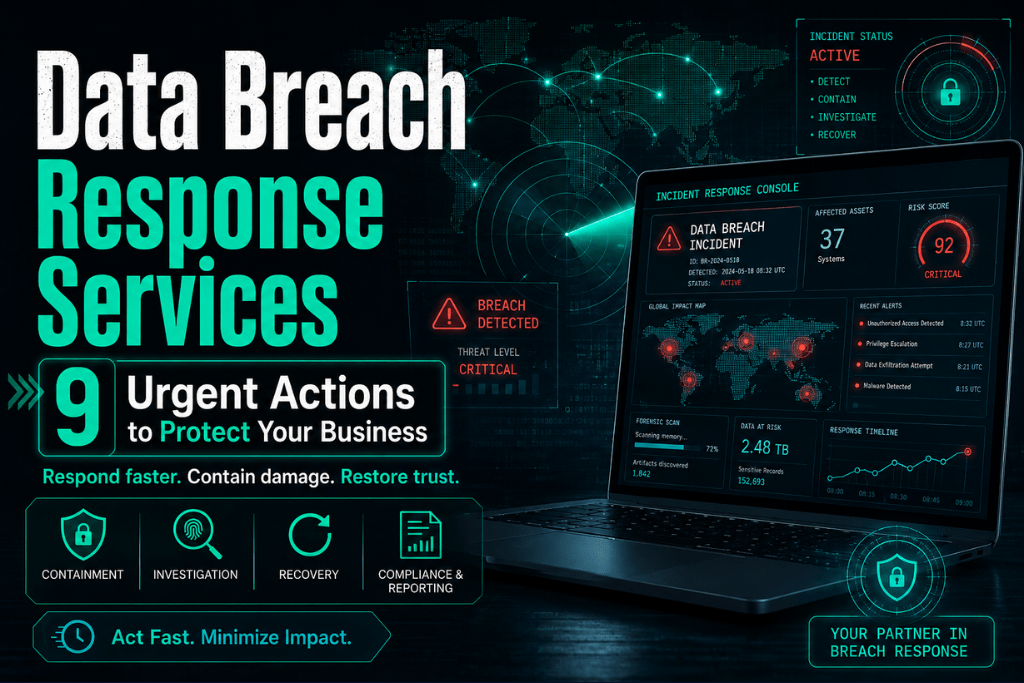
Data Breach Response Services: 9 Urgent Actions to Protect Your Business
Data Breach Response Services help businesses act quickly when sensitive data may have been accessed, stolen, leaked, deleted, modified, or exposed due to a cyber incident.
A data breach can happen through ransomware, phishing, weak passwords, cloud misconfiguration, insider activity, malware, exposed databases, compromised email accounts, or insecure APIs.
When a breach happens, businesses should not panic or guess.
They need a clear response plan, technical investigation, evidence preservation, containment, communication support, and recovery guidance.
In simple words, data breach response helps businesses understand what happened, stop further damage, protect affected data, and recover with confidence.
Table of Contents
I. What Are Data Breach Response Services?
II. Why Data Breach Response Services Matter
III. Common Causes of Data Breaches
IV. Data Breach Response Services: 9 Urgent Actions
V. What Should a Data Breach Response Report Include?
VI. Data Breach Response vs Incident Response
VII. Who We Are
VIII. What We Do
IX. Why We Are Different From Others
X. Which Businesses Need Data Breach Response Services?
XI. Final Thoughts
XII. FAQs
What Are Data Breach Response Services?
Data Breach Response Services are professional cybersecurity services that help businesses respond to confirmed or suspected data breaches.
These services focus on identifying what happened, which systems were affected, what data may have been exposed, how attackers gained access, and what steps should be taken next.
A data breach response may include technical investigation, digital forensics, incident response, log analysis, malware analysis, cloud review, email investigation, evidence preservation, containment, remediation, and recovery support.
The main goal is to reduce damage and help the business recover safely.
Why Data Breach Response Services Matter
A data breach can affect a business in many ways.
It can lead to financial loss, legal issues, customer complaints, compliance problems, operational downtime, and reputation damage.
The situation becomes worse when the response is delayed or handled incorrectly.
For example, if systems are formatted too early, logs are deleted, malware is removed without analysis, or accounts are reset without preserving evidence, the business may lose important information needed for investigation.
Data Breach Response Services help businesses answer important questions.
I. What data was exposed?
II. How did the breach happen?
III. Which systems, accounts, or databases were affected?
IV. Is the attacker still inside the environment?
V. Was customer data accessed or copied?
VI. What evidence is available?
VII. What should be fixed immediately?
VIII. What should be communicated to stakeholders?
IX. How can we prevent this from happening again?
A structured response helps businesses move from confusion to control.
Common Causes of Data Breaches
Data breaches can happen because of technical weaknesses, human error, poor access control, or targeted attacks.
Common causes include phishing emails, stolen passwords, weak authentication, missing MFA, ransomware, malware, exposed cloud storage, public databases, insecure APIs, weak access controls, insider misuse, poor logging, unpatched systems, and third-party vendor compromise.
Many breaches are not caused by one single issue.
Attackers often combine multiple small weaknesses to access sensitive data.
For example, a phishing email may steal an employee password. If MFA is missing, the attacker may enter the email account. From there, they may find cloud links, invoices, customer data, or internal credentials.
That is why data breach response should include both investigation and remediation.
Data Breach Response Services: 9 Urgent Actions
I. Confirm Whether a Data Breach Happened
The first step is to confirm whether the incident is actually a data breach.
Not every security alert is a breach. Sometimes it may be a failed login attempt, blocked malware, suspicious traffic, or system error.
However, if sensitive data was accessed, copied, exposed, changed, deleted, or leaked, it may qualify as a data breach.
Security experts review alerts, logs, user activity, affected systems, cloud records, email activity, and endpoint data to understand the situation clearly.
This prevents unnecessary panic and helps the business take the right action.
II. Contain the Breach Quickly
Once a breach is suspected or confirmed, containment is critical.
The goal is to stop further damage.
Containment may include disabling compromised accounts, blocking malicious IP addresses, isolating infected systems, restricting database access, removing exposed storage permissions, resetting risky credentials, or temporarily suspending affected services.
Containment should be done carefully.
If done incorrectly, it can destroy evidence or alert attackers before the business understands the full scope.
III. Preserve Digital Evidence
Evidence preservation is one of the most important parts of data breach response.
Important evidence may include server logs, email logs, cloud access records, firewall logs, endpoint data, database logs, malware samples, screenshots, file timestamps, user activity records, and network traffic records.
Businesses should avoid deleting files, formatting systems, clearing logs, or making unnecessary changes before the evidence is collected.
Proper evidence handling helps support technical investigation, legal review, compliance reporting, cyber insurance claims, and internal decision-making.
IV. Identify the Root Cause
A good data breach response should not only focus on what was exposed.
It should also identify how the breach happened.
The root cause may be phishing, weak passwords, stolen credentials, missing MFA, insecure API access, cloud misconfiguration, database exposure, vulnerable software, malware infection, insider activity, or third-party compromise.
Root cause analysis helps businesses fix the real issue instead of only treating the visible damage.
If the root cause is not fixed, the breach may happen again.
V. Understand What Data Was Affected
After containment and evidence preservation, the business must understand what data may have been exposed.
This may include customer names, emails, phone numbers, payment information, health records, employee files, financial documents, contracts, source code, login credentials, business documents, or database records.
This step is very important because the type of affected data influences legal, regulatory, client, and business decisions.
A breach involving public marketing data is very different from a breach involving payment details, health data, passwords, or government records.
VI. Check Whether Data Was Stolen or Only Exposed
There is a difference between exposed data and confirmed stolen data.
Data may be publicly accessible because of a cloud misconfiguration, but there may not be evidence that attackers downloaded it.
In other cases, logs may show large file downloads, unusual database queries, data transfer to unknown IP addresses, or suspicious archive creation.
Data breach response experts review logs, traffic patterns, cloud activity, endpoint artifacts, and attacker behavior to understand whether data was accessed, copied, or exfiltrated.
This helps the business assess the real impact.
VII. Communicate Carefully With Stakeholders
Communication after a breach must be handled carefully.
Different stakeholders may need different information. This may include management, IT teams, legal teams, customers, employees, vendors, clients, regulators, banks, or law enforcement.
The message should be accurate, clear, and based on verified facts.
Businesses should avoid making claims before the investigation is complete.
A good response process helps prepare communication based on what is known, what is still being investigated, and what actions are being taken.
VIII. Fix Security Gaps and Recover Systems
After the breach is contained and investigated, the business must fix the security gaps.
This may include patching systems, enabling MFA, improving access controls, securing cloud storage, rotating credentials, removing malware, updating firewall rules, improving API security, strengthening database protection, and reviewing vendor access.
Recovery should be done safely.
If systems are restored without fixing the root cause, attackers may return.
A strong recovery process includes validation, monitoring, and retesting.
IX. Review Lessons Learned and Improve Security
After the incident, the business should review what happened and improve its cybersecurity program.
This includes understanding what worked, what failed, what slowed down response, which alerts were missed, and which controls need improvement.
Lessons learned may lead to better incident response planning, stronger logging, improved employee training, regular VAPT, cloud security assessment, endpoint protection, SOC/SIEM monitoring, and better backup strategy.
A data breach should become a learning point, not just a one-time crisis.
What Should a Data Breach Response Report Include?
A professional data breach response report should be clear, evidence-based, and useful for both business and technical teams.
It should include the following information.
I. Executive summary explaining the breach in simple language.
II. Incident timeline showing when the breach started, when it was detected, and how it progressed.
III. Affected systems, accounts, databases, files, cloud resources, or applications.
IV. Evidence reviewed during investigation.
V. Root cause analysis explaining how the breach happened.
VI. Data exposure assessment explaining what data may have been affected.
VII. Indicators of compromise such as suspicious IPs, files, domains, accounts, or malware artifacts.
VIII. Containment and recovery actions taken.
IX. Remediation recommendations to reduce future risk.
X. Final conclusion and next steps.
The report should help management understand business impact and help technical teams fix the problem properly.
Data Breach Response vs Incident Response
Data breach response and incident response are closely related, but they are not exactly the same.
Incident response focuses on handling a cybersecurity incident. It may involve ransomware, malware, unauthorized access, server compromise, cloud compromise, phishing, or suspicious activity.
Data breach response focuses specifically on incidents where sensitive data may have been accessed, exposed, stolen, modified, deleted, or leaked.
In simple words, incident response handles the cyberattack. Data breach response focuses on the impact on data.
Many serious cases require both.
For example, a ransomware incident may need incident response to contain the attack and data breach response to check whether customer data was stolen before encryption.
Who We Are
Securium Solutions is a CERT-In Empanelled cybersecurity company helping businesses protect digital assets through VAPT, compliance audits, cloud security, digital forensics, incident response, SOC/SIEM monitoring, cyber fraud investigation, and managed security services.
We help businesses respond to cyber incidents, investigate data exposure, preserve digital evidence, and improve security after breaches.
What We Do
Securium Solutions provides expert-led cybersecurity services for businesses in India and global markets.
Our services include the following.
I. Data Breach Response Services.
II. Incident response.
III. Digital forensic analysis.
IV. Malware analysis.
V. Cyber fraud investigation.
VI. Email fraud investigation.
VII. VAPT services.
VIII. Cloud security assessment.
IX. Database security assessment.
X. SOC/SIEM monitoring.
XI. Compliance audits.
XII. Managed security services.
Why We Are Different From Others
Securium Solutions focuses on practical, evidence-based cybersecurity support.
We do not treat data breach response as only a technical clean-up activity.
A real breach response needs containment, evidence preservation, digital forensics, root cause analysis, data exposure review, remediation guidance, and recovery support.
We are different because we help businesses understand what happened, what data was affected, how attackers got access, what evidence exists, what needs to be fixed, and how to reduce repeat incidents.
As a CERT-In Empanelled cybersecurity company, Securium Solutions combines incident response, digital forensics, VAPT, SOC/SIEM monitoring, compliance audits, and managed security services under one roof.
Which Businesses Need Data Breach Response Services?
Any business that stores customer data, employee data, financial records, health records, payment details, source code, confidential documents, or business-critical data may need Data Breach Response Services.
These services are especially important for fintech companies, banking and finance businesses, SaaS platforms, ecommerce companies, healthcare organizations, insurance companies, EdTech platforms, payment companies, government vendors, cloud-based businesses, telecom companies, manufacturing companies, retail businesses, and enterprises with customer portals.
If your business depends on digital systems or stores sensitive information, data breach response readiness should be part of your cybersecurity strategy.
Final Thoughts
A data breach can create fear, confusion, business pressure, and reputational risk.
But the right response can make a major difference.
Data Breach Response Services help businesses contain incidents, preserve evidence, investigate root causes, understand data exposure, recover securely, and improve future security.
For modern businesses, data breach response is not optional. It is an essential part of cybersecurity, compliance, customer trust, and business continuity.
Need Data Breach Response Services in India?
Securium Solutions helps businesses respond to data breaches through expert-led Data Breach Response Services, incident response, digital forensic analysis, malware analysis, VAPT, cloud security assessment, SOC/SIEM monitoring, compliance audits, and managed cybersecurity services.
Contact Securium Solutions today to contain data breaches, investigate exposed data, preserve evidence, and recover securely.
FAQs
What are Data Breach Response Services?
Data Breach Response Services help businesses respond to incidents where sensitive data may have been accessed, exposed, stolen, modified, deleted, or leaked.
Why do businesses need Data Breach Response Services?
Businesses need Data Breach Response Services to contain the incident, preserve evidence, investigate root cause, understand affected data, reduce damage, and recover securely.
What is the first step after a data breach?
The first step is to confirm the incident and contain further damage while preserving evidence. Businesses should avoid deleting logs or formatting systems before investigation.
What causes most data breaches?
Common causes include phishing, weak passwords, missing MFA, ransomware, malware, cloud misconfiguration, exposed databases, insecure APIs, insider misuse, and unpatched systems.
What should a data breach response report include?
A data breach response report should include incident timeline, affected systems, evidence reviewed, root cause, data exposure details, containment actions, recovery steps, and remediation recommendations.
Is data breach response different from incident response?
Yes. Incident response handles cybersecurity incidents broadly, while data breach response focuses specifically on incidents where sensitive data may be exposed, stolen, modified, deleted, or leaked.
Why choose Securium Solutions?
Securium Solutions is a CERT-In Empanelled cybersecurity company offering Data Breach Response Services, incident response, digital forensic analysis, VAPT, cloud security assessment, SOC/SIEM monitoring, compliance audits, and managed security services.