Quick Answer: What Is Incident Response?
Incident response is the process of handling a cyberattack quickly and safely. It helps a business detect the problem, stop the attack from spreading, investigate what happened, remove the threat, and recover systems with minimum damage.
For example, if your company faces ransomware, malware infection, email compromise, unauthorized access, data breach, cloud compromise, or suspicious activity, incident response helps your team take the right steps without panic.
In simple words, incident response helps businesses act fast, control the damage, protect data, and recover securely after a cyber incident.
Why Incident Response Matters for Businesses
When a cyberattack happens, every minute matters.
Attackers may try to steal data, encrypt files, create hidden access, move across systems, or disrupt business operations. If the response is delayed or handled incorrectly, the damage can become much bigger.
Many businesses make mistakes during cyber incidents because they act in panic. They may shut down systems, delete files, format devices, remove malware, or change settings without understanding the full situation. This can destroy important evidence and make investigation difficult.
A proper incident response process helps businesses answer important questions like:
-
- What exactly happened?
- How serious is the incident?
- Which systems or accounts are affected?
- Is the attacker still inside the network?
- Was any data stolen?
- What should be done first?
- How can the business recover safely?
- How can this be prevented in the future?
Incident response is not only about fixing technical issues. It is about protecting business operations, customer trust, legal readiness, and brand reputation.
What Is Cyber Incident Response?
Cyber incident response is a structured process used to manage cybersecurity incidents. It helps businesses control the situation instead of reacting randomly.
The main goal is to:
-
- Detect the incident
- Contain the damage
- Investigate the root cause
- Remove the threat
- Restore affected systems
- Improve security after recovery
Incident response may be needed for many situations, including:
-
- Ransomware attacks
- Malware infections
- Data breaches
- Phishing attacks
- Business email compromise
- Unauthorized access
- Server compromise
- Website compromise
- Cloud account compromise
- Insider threats
- Suspicious network activity
- Credential theft
- DDoS attacks
- API abuse
- Endpoint compromise
A strong incident response process helps businesses move from confusion to control.
When Does a Business Need Incident Response Services?
A business needs incident response services whenever there is a confirmed cyberattack or even a strong suspicion of one.
Some warning signs include:
-
- Files suddenly encrypted or renamed
- A ransom note appearing on systems
- Unknown login attempts
- Suspicious admin activity
- Unusual outbound traffic
- Website defacement
- Unexpected server behavior
- Malware alerts
- Employee email sending spam
- Unauthorized password changes
- Deleted or modified files
- Unknown user accounts created
- Cloud resources changed without approval
- Sudden system slowdown
- Data leakage suspicion
Even if you are not sure whether the incident is real, early investigation is always better. Small signs can sometimes point to a larger compromise.
Common Cyber Incidents Businesses Face
1. Ransomware Attacks
Ransomware is one of the most damaging cyber incidents for any business. It can lock files, stop operations, and demand payment for recovery.
Incident response helps businesses:
-
- Isolate infected systems
- Stop ransomware from spreading
- Identify how attackers entered
- Check whether data was stolen
- Review backup recovery options
- Remove attacker access
- Restore systems safely
- Improve security after recovery
The goal is not only to recover files but also to make sure attackers cannot return.
2. Business Email Compromise
Business email compromise happens when attackers gain access to a company email account and misuse it for fraud.
They may send fake payment instructions, change invoice details, redirect funds, or steal sensitive communication.
Incident response helps investigate:
-
- Suspicious login activity
- Unauthorized mailbox access
- Mailbox forwarding rules
- Deleted emails
- Fake payment instructions
- Phishing emails
- Compromised credentials
This helps businesses stop fraud quickly and secure affected email accounts.
3. Malware Infection
Malware can steal data, monitor activity, damage systems, or give attackers remote access.
Incident response helps businesses:
-
- Identify infected systems
- Remove malicious files
- Understand malware behavior
- Block attacker communication
- Review endpoint activity
- Patch affected systems
- Prevent reinfection
Removing malware without proper investigation can leave hidden backdoors behind. That is why a structured response is important.
4. Data Breach
A data breach can expose customer records, financial data, employee information, business documents, or confidential files.
Incident response helps businesses:
-
- Identify what data was accessed
- Understand how the breach happened
- Contain affected systems
- Preserve evidence
- Support client or regulatory communication
- Improve security controls
The faster a data breach is handled, the lower the potential business damage.
5. Unauthorized Access
Unauthorized access may happen because of weak passwords, stolen credentials, phishing, exposed services, or insider misuse.
Incident response helps review:
-
- Login records
- Privilege changes
- Suspicious IP addresses
- Access timestamps
- Compromised accounts
- Affected systems
- Attacker movement
This helps businesses remove unauthorized access and secure affected systems.
6. Cloud Security Incident
Many businesses use AWS, Azure, Google Cloud, Microsoft 365, Google Workspace, and other cloud platforms. If a cloud account is compromised, attackers may access data, change configurations, create new resources, or steal credentials.
Incident response helps investigate:
-
- Cloud login activity
- IAM changes
- Exposed storage
- Suspicious API activity
- Privilege escalation
- Data access records
- Cloud configuration changes
Cloud incidents need quick and careful handling because cloud environments can change very fast.
Incident Response Process
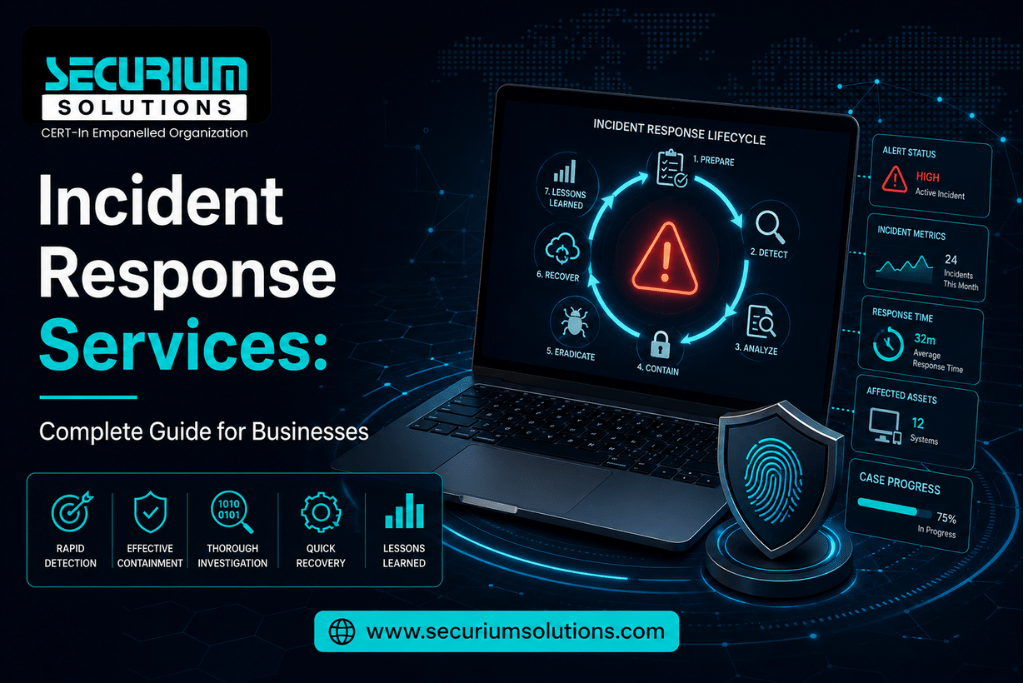
A professional incident response process follows clear steps. This helps reduce confusion and ensures the right actions are taken at the right time.
Step 1: Preparation
Preparation happens before an incident.
It includes having security policies, response plans, backup strategy, logging, monitoring, access controls, and clear responsibilities.
Businesses that prepare early usually respond faster and recover better during real attacks.
Step 2: Detection and Identification
The first active step is to confirm whether a security incident has occurred.
Experts review alerts, logs, endpoint activity, user reports, server behavior, network traffic, and suspicious activity.
The goal is to understand what type of incident it is and how serious it may be.
Step 3: Containment
Containment means stopping the attack from spreading.
This may include:
-
- Isolating infected systems
- Disabling compromised accounts
- Blocking malicious IP addresses
- Restricting access
- Disconnecting affected servers
- Stopping suspicious processes
Containment must be done carefully because important evidence should not be destroyed.
Step 4: Investigation
After the incident is contained, experts investigate what happened.
They may review:
-
- System logs
- Endpoint activity
- Emails
- Cloud activity
- Network traffic
- Malware behavior
- User account activity
- System changes
This helps identify the root cause, affected assets, and attacker activity.
Step 5: Eradication
Eradication means removing the threat completely.
This may include:
-
- Removing malware
- Closing attacker access points
- Deleting unauthorized accounts
- Patching vulnerabilities
- Rotating passwords and keys
- Fixing misconfigurations
- Removing persistence mechanisms
The goal is to make sure attackers cannot return using the same path.
Step 6: Recovery
Recovery means bringing systems back safely.
This may include restoring backups, rebuilding servers, validating system integrity, bringing applications online, and monitoring for suspicious activity.
Recovery should be done carefully. If infected backups or vulnerable systems are restored, the incident may happen again.
Step 7: Post-Incident Review
After recovery, businesses should review the incident.
This helps answer:
-
- What caused the incident?
- What worked well during response?
- What slowed down recovery?
- Which security controls failed?
- What should be improved?
This step helps strengthen future cybersecurity readiness.
Step 8: Reporting and Recommendations
A final incident response report gives a clear summary of what happened, what was affected, what actions were taken, and what should be improved.
This report is useful for management, IT teams, compliance teams, legal teams, and business leaders.
What Should an Incident Response Report Include?
A good incident response report should be clear, practical, and easy to understand.
It should include:
-
- Executive summary
- Incident overview
- Timeline of events
- Affected systems or accounts
- Initial detection details
- Root cause analysis
- Containment actions
- Investigation findings
- Indicators of compromise
- Evidence collected
- Business impact
- Data exposure observations
- Recovery actions
- Remediation steps
- Security recommendations
- Final conclusion
The report should help the business understand what happened and what needs to be fixed next.
Incident Response vs Digital Forensics
Incident response and digital forensics are closely connected, but they are not the same.
Incident response focuses on action. It helps contain the attack, remove the threat, restore systems, and reduce business damage.
Digital forensics focuses on investigation. It helps collect evidence, analyze what happened, identify the root cause, and support legal or internal action.
In many serious cyber incidents, businesses need both.
Incident response helps the business recover. Digital forensics helps the business understand the full story behind the incident.
Why Businesses Should Have an Incident Response Plan
Waiting until an attack happens is risky. Businesses should have an incident response plan before they need it.
An incident response plan helps define:
-
- Who should respond
- Who should be informed
- Which systems are critical
- How to isolate affected systems
- How to preserve evidence
- How to communicate internally
- How to contact external experts
- How to recover from backups
- How to report the incident
- How to prevent repeat attacks
A clear plan reduces panic and helps teams act faster during emergencies.
Which Businesses Need Incident Response Services?
Any business that depends on digital systems should be ready for cyber incidents.
Incident response services are especially important for:
-
- Fintech companies
- Banking and finance businesses
- Healthcare organizations
- SaaS companies
- Ecommerce businesses
- Insurance companies
- Government organizations
- Educational institutions
- Manufacturing companies
- Retail businesses
- Telecom companies
- Cloud-based businesses
- Enterprises with remote teams
- Businesses handling customer data
- Companies with payment systems or online platforms
If your business uses emails, servers, cloud systems, databases, applications, or digital transactions, incident response should be part of your cybersecurity strategy.
Business Benefits of Incident Response
Incident response gives businesses control during stressful cyber situations.
Faster Threat Containment
It helps stop attackers before they spread further across systems.
Reduced Downtime
A structured response helps businesses recover faster and reduce operational disruption.
Better Damage Control
Incident response helps reduce data loss, financial impact, legal risk, and reputation damage.
Stronger Root Cause Identification
It helps businesses understand how the incident happened and what needs to be fixed.
Improved Compliance Readiness
A documented response process helps with audit, regulatory, client, and legal requirements.
Better Future Security
After the incident, businesses can improve controls, monitoring, policies, backups, and employee awareness.
Why Choose Securium Solutions for Incident Response?
Incident response requires speed, technical expertise, investigation skills, and practical recovery guidance.
Securium Solutions is a CERT-In Empanelled cybersecurity company offering professional incident response, digital forensic analysis, malware analysis, cyber fraud investigation, email fraud investigation, VAPT, compliance audits, cloud security assessment, SOC/SIEM monitoring, and managed security services.
Our expert-led approach helps businesses contain threats, investigate incidents, identify root causes, preserve evidence, and recover securely.
Whether your organization is facing ransomware, email compromise, malware infection, data breach, cloud compromise, or unauthorized access, Securium Solutions can help you respond quickly and reduce business impact.
Final Thoughts
A cyber incident can create confusion, pressure, and business disruption. But the right response can make a major difference.
Incident response helps businesses act quickly, contain damage, investigate the root cause, recover systems, and improve security after the incident.
For modern businesses, incident response is not optional. It is an essential part of cybersecurity, compliance, customer trust, and business continuity.
Need Cyber Incident Response Services in India?
Securium Solutions helps businesses respond to cyber incidents through expert-led incident response, digital forensic analysis, malware analysis, cyber fraud investigation, VAPT, cloud security assessment, SOC monitoring, and managed cybersecurity services.
Contact Securium Solutions today to contain cyber threats, investigate incidents, and recover your business securely.
FAQs
What is incident response?
Incident response is the process of identifying, containing, investigating, removing, and recovering from a cybersecurity incident.
Why do businesses need incident response?
Businesses need incident response to reduce damage, stop attacks from spreading, protect data, recover systems, and prevent similar incidents in the future.
What types of incidents require incident response?
Common incidents include ransomware, malware infection, data breach, business email compromise, unauthorized access, cloud compromise, phishing attacks, and server compromise.
How quickly should incident response start?
Incident response should start as soon as suspicious activity is detected. A faster response can reduce damage, downtime, and data loss.
What is the difference between incident response and digital forensics?
Incident response focuses on containment and recovery, while digital forensics focuses on evidence collection, investigation, and root cause analysis.
What should an incident response report include?
It should include incident summary, timeline, affected systems, root cause, evidence, containment actions, recovery steps, business impact, and security recommendations.
Why choose Securium Solutions?
Securium Solutions is a CERT-In Empanelled cybersecurity company offering expert incident response, digital forensics, malware analysis, VAPT, compliance audits, cloud security, SOC/SIEM monitoring, and managed security services.