An audio recording can make or break a case. A voice message alleging extortion. A phone call recording in a corporate fraud matter. A disputed sting operation recording submitted as evidence in a criminal case. In each of these situations, a critical question must be answered: is this recording authentic? Has it been edited, spliced, or manipulated? And can the voice on the recording be positively identified?
These are the questions that audio forensic examination is designed to answer — scientifically, objectively, and to a standard that withstands cross-examination in court.
What is Audio Forensics?
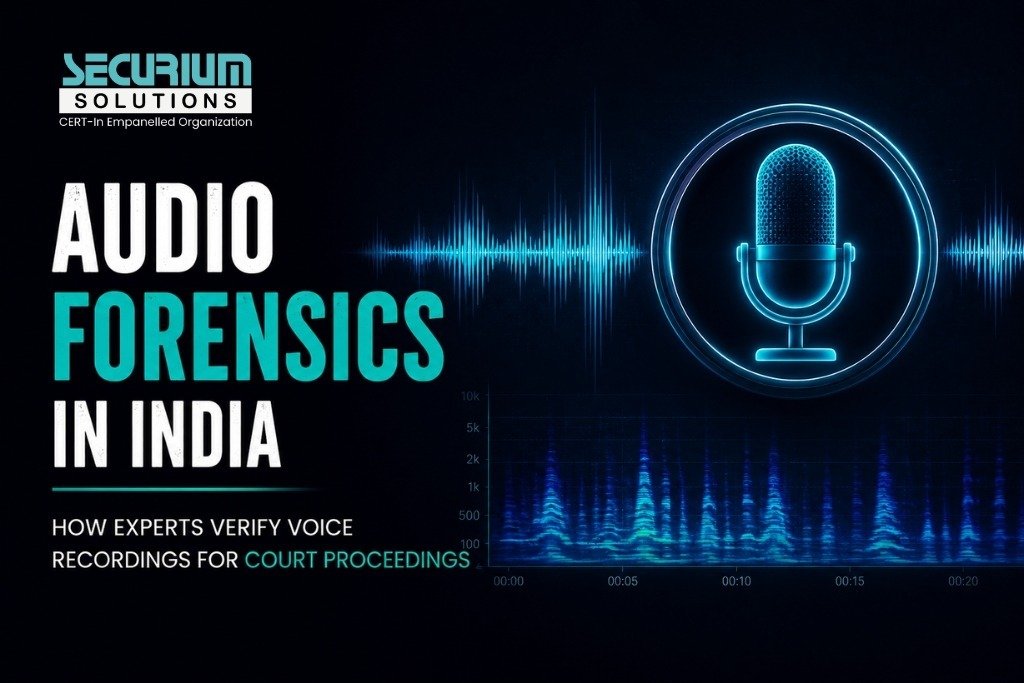
Audio forensics is the application of scientific analysis to audio recordings submitted as evidence in legal, criminal, or investigative proceedings. It encompasses three primary areas of examination:
- Determining whether a specific individual is the speaker on a recording, based on acoustic and linguistic analysis of vocal characteristics.
- Determining whether a recording is an authentic, unmodified capture of a real event — or whether it has been edited, spliced, or artificially created.
- Improving the intelligibility of poor-quality recordings by reducing background noise, correcting frequency imbalances, and clarifying speech content.
How is Voice Identification Performed?
Voice identification — formally known as forensic speaker comparison — involves comparing the voice on an evidential recording (the questioned voice) against a known sample recording from a suspect or identified speaker. The process involves:
- Acoustic phonetic analysis — examining the physical properties of the voice including pitch, formant frequencies, speaking rate, and voice quality
- Spectrographic comparison — visual analysis of voice print patterns using spectrographic imaging
- Linguistic analysis — examining speech patterns, vocabulary, accent, and idiolect features
- Automatic speaker recognition — using validated computational tools to calculate the likelihood ratio of the voices being the same person vs different people
Voice identification findings are expressed as a likelihood ratio — how much more likely it is that the known and questioned voices are the same person versus different people. This probabilistic framework is consistent with scientific best practice for forensic evidence.
How is Audio Authenticity Determined?
Audio authenticity analysis examines a recording for signs of editing, splicing, insertion, deletion, or artificial manipulation. Techniques used include:
- Analysis of background noise consistency — discontinuities in background sound can indicate cuts
- Examination of electrical network frequency (ENF) patterns embedded in recordings made near power sources — which can be used to verify recording date and time
- Spectral analysis identifying digital artefacts caused by audio editing software
- Analysis of metadata embedded in the audio file — checking for inconsistencies between file creation date, recording software, and device information
- Detection of re-recording artefacts — signs that a recording was played back and re-recorded to disguise original content
Audio Enhancement — Making Inaudible Content Clear
Many audio recordings submitted for forensic examination are of poor quality — captured on a hidden device, recorded in a noisy environment, or transmitted over a low-quality communication channel. Audio enhancement uses signal processing techniques to improve intelligibility:
- Noise reduction — removing consistent background sounds (traffic, air conditioning, crowd noise)
- Equalisation — adjusting frequency balance to make speech more intelligible
- De-reverberation — reducing echo and room reflection effects
- Volume normalisation — correcting for inconsistent recording levels
Important note: audio enhancement improves intelligibility but does not create content that was not captured in the original recording. Our enhanced recordings are produced alongside the original for comparison, and any transcript prepared from enhanced audio is clearly noted as such in our report.
Frequently Asked Questions
Can a voice recording made on a smartphone be used as evidence in an Indian court?
Yes — audio recordings are admissible as electronic evidence under Section 65B of the Indian Evidence Act, subject to proper authentication and a certificate from the person responsible for the electronic record. A forensic examination report from a certified examiner significantly strengthens the admissibility and weight given to a recorded piece of evidence.
Can a WhatsApp voice note or audio message be forensically analysed?
Yes. WhatsApp voice notes are audio files that can be subjected to the same forensic analysis as any other audio recording — including authenticity verification, voice comparison, and enhancement. They can also be recovered from mobile devices using forensic extraction tools, even after they have been deleted from the app.
How long does audio forensic examination take?
Standard audio authenticity examination takes 3–5 working days for recordings up to 30 minutes. Voice identification examination involving comparison against known samples typically takes 5–7 working days. Enhancement work is usually completed in 2–3 working days. Priority turnaround is available.
📞 CALL TO ACTION
Need audio forensic examination in India? Securium Forensic Lab provides voice identification, authenticity analysis, and audio enhancement with court-admissible expert reports.
📞 +91 8368545467 | 📧 sunil.singh@securiumsolutions.org