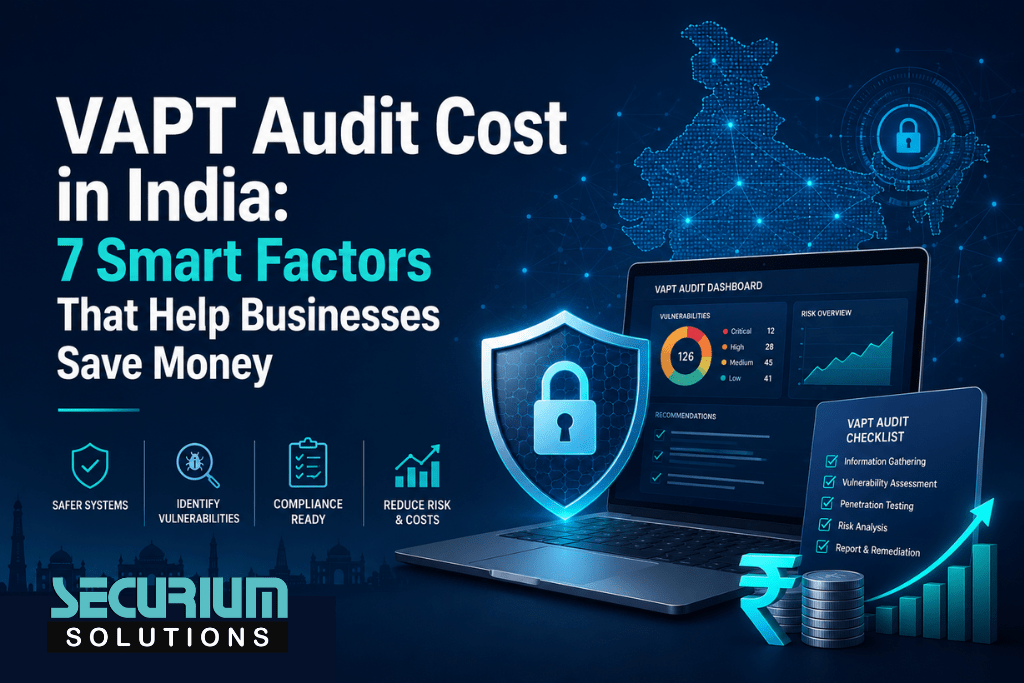
VAPT Audit Cost in India usually depends on what you want to test, how complex your application or infrastructure is, and how deep the security testing needs to be.
A small business website may cost much less to audit than a fintech app, ecommerce platform, SaaS product, API system, cloud setup, or enterprise network.
So, there is no single fixed price for every VAPT audit.
In simple words, the cost depends on your risk, your assets, and the level of testing your business needs.
A basic automated scan may look cheaper, but it may miss serious issues. A professional VAPT audit includes manual testing, vulnerability validation, proof of concept, business impact analysis, remediation guidance, and retesting.
For businesses handling customer data, payments, applications, APIs, or cloud systems, VAPT is not just a security expense. It is an investment in trust, compliance, and business protection.
Table of Contents
- What Is a VAPT Audit?
- Why VAPT Audit Cost in India Is Not Fixed
- Average VAPT Audit Cost in India
- 7 Smart Factors That Affect VAPT Audit Cost in India
- Cheap VAPT vs Professional VAPT Audit
- What Should Be Included in VAPT Audit Cost?
- Who We Are
- What We Do
- Why We Are Different From Others
- When Should Businesses Conduct a VAPT Audit?
- Which Businesses Need a VAPT Audit?
- Final Thoughts
- FAQs
What Is a VAPT Audit?
A VAPT audit means Vulnerability Assessment and Penetration Testing.
It is a cybersecurity testing process that helps businesses find security weaknesses in websites, applications, mobile apps, APIs, networks, cloud systems, servers, and databases.
Vulnerability Assessment helps identify possible security gaps.
Penetration Testing goes deeper and checks whether those vulnerabilities can actually be exploited by attackers.
A proper VAPT audit helps businesses understand:
- Where the vulnerabilities are
- How serious they are
- Whether attackers can exploit them
- What business impact they can create
- Which issues should be fixed first
- Whether the fixes are working after remediation
This makes VAPT important for businesses that want to protect customer data, avoid security incidents, meet compliance requirements, and build client confidence.
Why VAPT Audit Cost in India Is Not Fixed
VAPT Audit Cost in India is not the same for every business because every business has a different digital setup.
For example, testing a small informational website is very different from testing a fintech platform with login systems, payment flows, APIs, customer data, admin panels, and multiple user roles.
Similarly, testing one public IP address is different from testing a full internal network with servers, VPNs, firewalls, employee systems, and cloud infrastructure.
The cost usually depends on:
- Number of assets
- Application size
- Testing depth
- Manual effort required
- Compliance requirements
- Report quality
- Retesting needs
- Time required by security experts
A good cybersecurity company will first understand your scope and then provide a cost based on your actual requirement.
Average VAPT Audit Cost in India
The average VAPT Audit Cost in India can vary widely depending on the scope.
Here is a general idea:
| VAPT Scope | Approximate Cost Range in India |
|---|---|
| Small website or basic web application | ₹25,000 – ₹60,000 |
| Medium web application | ₹60,000 – ₹1,50,000 |
| Large web application | ₹1,50,000 – ₹4,00,000+ |
| Mobile application VAPT | ₹60,000 – ₹2,00,000+ |
| API penetration testing | ₹50,000 – ₹2,50,000+ |
| External network VAPT | ₹40,000 – ₹1,20,000+ |
| Internal network VAPT | ₹80,000 – ₹2,00,000+ |
| Cloud security assessment | ₹1,00,000 – ₹5,00,000+ |
| Enterprise multi-asset VAPT | Custom pricing |
These are only indicative ranges. Final pricing depends on the actual scope, asset count, complexity, testing method, compliance needs, and reporting expectations.
7 Smart Factors That Affect VAPT Audit Cost in India
1. VAPT Audit Cost in India Depends on Scope
Scope is the biggest factor in VAPT pricing.
If you want to test one website, the cost will be lower. If you want to test a website, mobile app, APIs, cloud infrastructure, and network together, the cost will naturally increase.
Common VAPT scope items include:
- Web applications
- Mobile applications
- APIs
- External IPs
- Internal networks
- Cloud infrastructure
- Databases
- Source code
- Admin panels
- Payment workflows
The larger the scope, the more time and technical effort the audit requires.
2. VAPT Audit Cost in India Depends on Application Complexity
A simple website is easier to test than a complex business application.
Application complexity increases when there are:
- Multiple user roles
- Login and registration systems
- Payment gateway integration
- Customer dashboard
- Admin panel
- File upload feature
- API connections
- Business logic workflows
- Sensitive data processing
- Third-party integrations
For example, testing a normal brochure website is much faster than testing a SaaS platform where different users have different permissions.
More complexity means more manual testing, more validation, and more reporting effort.
3. Testing Depth Affects VAPT Pricing
Not every VAPT audit gives the same level of security value.
Some low-cost audits may depend mostly on automated tools. These tools can find common issues, but they often miss deeper vulnerabilities.
A professional VAPT audit should include both automated scanning and manual testing.
Manual testing is important for finding issues such as:
- Broken access control
- Business logic flaws
- Payment flow manipulation
- Authentication bypass
- API authorization issues
- Privilege escalation
- Chained vulnerabilities
Manual testing takes more time, but it gives better results and more practical security value.
4. Asset Type Changes VAPT Audit Cost in India
Different assets need different testing methods.
For example, web application testing is different from mobile app testing. API testing is different from network testing. Cloud security assessment is different from database testing.
Here is how asset type affects cost:
- Web app testing checks forms, sessions, input fields, login systems, and access control.
- Mobile app testing checks APK or IPA files, local storage, API traffic, and reverse engineering risks.
- API testing checks authentication, authorization, rate limiting, and data exposure.
- Network testing checks ports, firewalls, VPNs, services, and segmentation.
- Cloud testing checks IAM, storage, security groups, logs, and misconfigurations.
Because each asset needs a different skill set and methodology, the cost also changes.
5. Compliance Requirements Can Increase VAPT Cost
Many businesses need VAPT for compliance, vendor onboarding, enterprise client reviews, payment gateway approval, or regulatory expectations.
Compliance-based VAPT may require more detailed documentation, executive summaries, evidence, retesting, closure reports, and audit-ready formatting.
Businesses may need VAPT for:
- ISO 27001
- PCI DSS
- SOC 2
- GDPR
- HIPAA
- RBI-related security expectations
- SEBI cybersecurity framework
- Payment gateway security reviews
- Enterprise client security requirements
You can also refer to the CERT-In Auditor Guidelines to understand professional audit expectations and secure audit practices.
If your business needs a compliance-ready report, the VAPT cost may be higher than a basic security test.
6. Report Quality and Retesting Affect Pricing
A VAPT report should be more than a list of vulnerabilities.
A good report should help your technical team fix issues and help your management team understand business risk.
A professional VAPT report should include:
- Executive summary
- Scope of testing
- Testing methodology
- Vulnerability details
- Severity rating
- Business impact
- Technical impact
- Proof of concept
- Screenshots or evidence
- Affected URLs, endpoints, or IPs
- Remediation steps
- Retesting status
- Final recommendations
Retesting is also important.
After your team fixes the vulnerabilities, retesting confirms whether the issues are actually resolved.
Some companies include one round of retesting in the price. Others charge separately. So, always confirm this before finalizing the audit.
7. Cybersecurity Company Expertise Matters
The experience of the cybersecurity company plays a major role in the final cost.
A very low-cost provider may only run automated tools and share a basic report. A professional cybersecurity company will perform deeper manual testing, validate findings, explain risk clearly, and provide practical remediation guidance.
Before choosing a VAPT partner, check:
- CERT-In empanelment
- Manual testing capability
- Sample report quality
- Industry experience
- Compliance knowledge
- Retesting support
- Remediation guidance
- Data handling practices
- Communication quality
Choosing the cheapest option may save money in the beginning, but it can become costly if serious vulnerabilities are missed.
Cheap VAPT vs Professional VAPT Audit
Many businesses search for the lowest VAPT Audit Cost in India, but the cheapest audit is not always the best choice.
Cheap VAPT may be enough for a very basic check, but it may not be enough for businesses that handle sensitive data, payments, APIs, customer accounts, cloud systems, or compliance requirements.
A low-quality audit may miss serious issues such as:
- Broken access control
- Business logic flaws
- API authorization issues
- Payment flow abuse
- Authentication bypass
- Privilege escalation
- Sensitive data exposure
A professional VAPT audit focuses on actual risk, not just tool output.
For better testing quality, businesses can also follow recognized security references such as the OWASP Web Security Testing Guide and the OWASP API Security Project.
The better question is not only, “What is the cost of VAPT?”
The better question is:
Will this VAPT audit actually help reduce my business risk?
What Should Be Included in VAPT Audit Cost?
Before finalizing any VAPT vendor, businesses should clearly ask what is included in the cost.
A good VAPT audit package should include:
- Scope discussion
- Asset understanding
- Manual and automated testing
- Vulnerability validation
- Risk rating
- Proof of concept
- Business impact explanation
- Technical remediation steps
- Executive summary
- Developer-friendly report
- Retesting support
- Final closure report
You should also ask whether the price includes:
- One-time testing or recurring testing
- One round of retesting
- Compliance-specific reporting
- Remediation consultation
- Multiple user-role testing
- API testing
- Cloud or network testing
- Post-audit support
Clear scope helps avoid confusion later.
Who We Are
Securium Solutions is a CERT-In Empanelled cybersecurity company helping businesses protect digital assets through VAPT, compliance audits, cloud security, digital forensics, incident response, SOC/SIEM monitoring, and managed security services.
We help startups, enterprises, fintech companies, SaaS platforms, healthcare businesses, ecommerce brands, government-related organizations, and businesses that handle sensitive data.
What We Do
Securium Solutions provides expert-led cybersecurity services such as:
- VAPT services
- Web application penetration testing
- Network penetration testing
- Mobile application penetration testing
- API penetration testing
- Cloud security assessment
- Database security assessment
- Source code review
- CERT-In security audit
- Digital forensic analysis
- Incident response
- SOC/SIEM monitoring
- Managed security services
You can explore related internal pages here:
- Securium Solutions Cybersecurity Services
- CERT-In Empanelled Security Audit
- Digital Forensic Services
- Contact Securium Solutions
Why We Are Different From Others
Securium Solutions focuses on practical and business-focused cybersecurity.
We do not treat VAPT as a checklist activity. Our goal is to help businesses understand real risk and fix vulnerabilities properly.
We are different because we focus on:
- Manual testing with expert validation
- Clear reporting for business and technical teams
- Practical remediation guidance
- CERT-In empanelled audit credibility
- Web, mobile, API, cloud, network, and database security
- Post-audit assistance and retesting support
- Human-led threat understanding
Our goal is not only to find vulnerabilities. Our goal is to help your business reduce cyber risk.
When Should Businesses Conduct a VAPT Audit?
Businesses should not wait for a cyberattack before testing their systems.
You should conduct VAPT:
- Before launching a new website
- Before releasing a mobile app
- Before payment gateway integration
- After major code changes
- After API updates
- After cloud migration
- Before compliance audits
- Before enterprise client onboarding
- After a security incident
- At least once or twice a year
Regular VAPT helps businesses stay ahead of attackers and reduce security risk.
Which Businesses Need a VAPT Audit?
A VAPT audit is useful for any business that uses digital systems.
It is especially important for:
- Fintech companies
- Banking and finance businesses
- SaaS platforms
- Ecommerce businesses
- Healthcare organizations
- EdTech platforms
- Insurance companies
- Government vendors
- Payment companies
- Cloud-based businesses
- Mobile app companies
- Enterprises with customer portals
- Businesses handling personal data
- Companies preparing for compliance audits
If your business stores customer data, accepts payments, uses APIs, manages cloud infrastructure, or runs business applications, VAPT should be part of your cybersecurity strategy.
Final Thoughts
VAPT Audit Cost in India depends on scope, complexity, asset type, testing depth, compliance needs, reporting quality, retesting, and the expertise of the cybersecurity company.
A low-cost audit may look attractive, but it may not always provide deep testing or useful remediation guidance.
A professional VAPT audit helps businesses identify real vulnerabilities, reduce cyber risk, protect customer data, meet compliance expectations, and build trust with clients.
For modern businesses, VAPT is not just an expense. It is a smart investment in security, compliance, and business continuity.
Need VAPT Audit Services in India?
Securium Solutions helps businesses secure websites, applications, APIs, networks, cloud infrastructure, and databases through expert-led VAPT audits, compliance audits, SOC/SIEM monitoring, incident response, and managed cybersecurity services.
Contact Securium Solutions today to understand your VAPT audit scope, get a clear cost estimate, and protect your business before attackers exploit security gaps.
FAQs
What is the average VAPT Audit Cost in India?
The average VAPT Audit Cost in India may start from around ₹25,000 for a small web application and can go up to several lakhs for complex applications, mobile apps, APIs, networks, cloud systems, or enterprise scopes.
Why does VAPT Audit Cost in India vary so much?
VAPT cost varies because every project has a different scope, asset count, complexity, testing depth, compliance requirement, reporting need, and retesting expectation.
Is cheap VAPT audit enough for businesses?
Cheap VAPT may be useful for basic checks, but it may miss serious issues if it depends only on automated scanning. Businesses should choose professional manual testing for better security value.
What is included in a professional VAPT audit?
A professional VAPT audit usually includes scope discussion, manual and automated testing, vulnerability validation, risk rating, proof of concept, business impact, remediation steps, reporting, and retesting.
Does VAPT cost include retesting?
Some cybersecurity companies include one round of retesting in the VAPT cost, while others charge separately. Businesses should confirm this before finalizing the audit.
How often should businesses conduct VAPT?
Businesses should conduct VAPT at least once or twice a year and after major changes such as new application launches, API updates, cloud migration, payment integration, or security incidents.
Why choose Securium Solutions for VAPT audit?
Securium Solutions is a CERT-In Empanelled cybersecurity company offering expert-led VAPT audits, web application testing, API testing, mobile app testing, cloud security assessment, database security assessment, compliance audits, SOC/SIEM monitoring, and incident response.